Generative video for D2C ads in 2026: what Veo and Firefly are actually good for, and what Sora’s shutdown teaches
A year ago the question was which AI video model looks best. In 2026 the better questions are which one will still exist next quarter, which one your lawyer is comfortable with, and which shots it should never be trusted with.
Key takeaways
- OpenAI closed the Sora app in April 2026 and its video API in September 2026. If your workflow depends on one model, plan for it to disappear.
- Google’s Veo 3.1 is the active flagship, with a cheaper Lite tier since April 2026. Inside Adobe Firefly, only Adobe’s own model carries Adobe’s “commercially safe” assurances; partner models don’t.
- Our cost arithmetic shows generation fees are small next to retries and review time. Budget for attempts and people, not seconds of video.
- Use AI video for B-roll, texture, mood and transitions. Keep it away from your packaging, legible text, real people’s faces and any product claim.
If you run ads for a D2C brand, you’ve probably been pitched AI video at least once this year: a perfect product reveal, a model who never needs a reshoot, a whole campaign made over a weekend. Some of that is real. Some of it falls apart the moment your actual packaging has to appear on screen.
This post skips the demo reels. It covers what changed in 2026, which shots AI video is genuinely good for in a small brand’s ads, what a reel actually costs once you count retries, and a test you can run in one afternoon before committing a budget.


What changed in 2026
Sora is gone
OpenAI told developers in March 2026 that it would discontinue Sora. The consumer app closed on 26 April 2026 and the Sora 2 API was switched off on 24 September 2026, with no replacement announced45. Teams that had built workflows, templates or client promises around it had a few months to move.
The lesson isn’t about OpenAI. It’s that AI video models are products, and products get discontinued. Treat any single model as a supplier you might lose, and keep your prompts, reference images and storyboards in a form you can take to another tool.
Veo got cheaper
Google released Veo 3.1 in October 2025 and added Veo 3.1 Lite, a lower-cost tier for text-to-video and image-to-video, in preview on 2 April 202612. At launch, Veo 3.1 and Sora 2 were among the most expensive video models to run3. The Lite tier changes the maths for short social clips, where 720p is often enough.
Firefly became a marketplace, with different rules inside it
Adobe’s Firefly now offers its own models alongside partner models from companies including Google, OpenAI, ByteDance and Kling8. That’s convenient, but the terms aren’t uniform. Adobe positions output from its own Firefly model as commercially safe and trained on licensed and public-domain content; partner models can be used commercially, but without the same assurances6. Enterprise customers can get indemnity for Firefly-model output specifically7. If a lawyer or a big retail client asks “is this safe to use?”, the honest answer depends on which model made the clip, not which app you opened.
What to do about it
Keep a model-neutral prompt library: a shared document with each prompt, the reference images used, the model and version, the settings and the date. Store the clips you keep with that record beside them. If a model is discontinued or its look changes after an update, you can recreate a shot in another tool instead of starting from memory. It takes five minutes per shot and saves days when a supplier disappears.
What AI video is good for in a D2C ad
Most D2C ads on Meta are 6 to 30 seconds, built from a hook, a few product moments, proof and a call to action. AI video is useful in some of those slots and risky in others. This is our working split for client work.
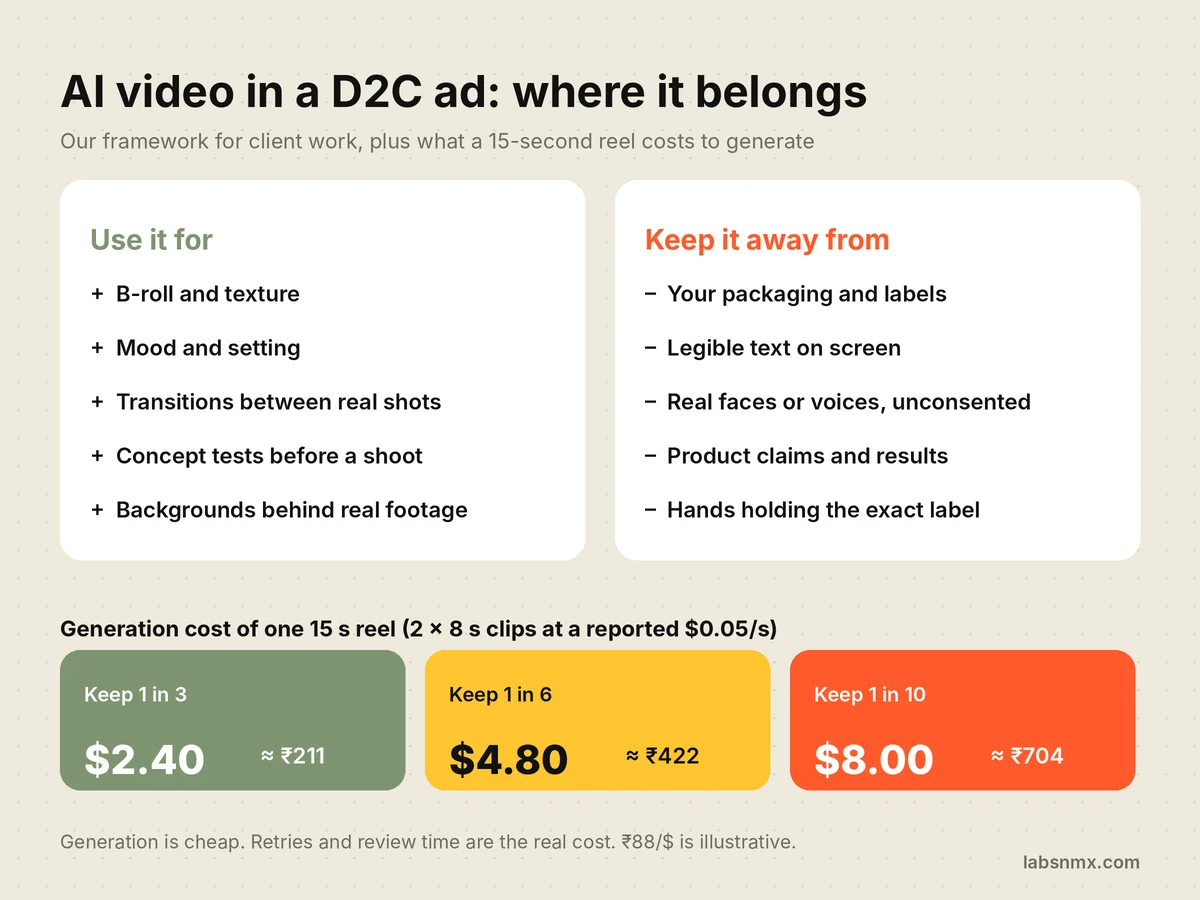
| Use it for | Keep it away from |
|---|---|
| B-roll and texture: steam over chai, rain on a window, fabric moving, spices falling | Your packaging: labels warp, logos melt, text turns to nonsense |
| Mood and setting: a Kerala backwater at dawn, a Mumbai local at night, a festive living room | Legible text on screen: add text in your editor, never in the generation |
| Transitions: morphs, reveals and camera moves between real shots | Real people’s faces or voices without written consent, including founders |
| Concept tests: rough versions of three ideas before you pay for a shoot | Product claims: “before and after”, results, ingredients in action |
| Backgrounds behind real product footage you shot yourself | Hands holding the product where the exact label must be readable |
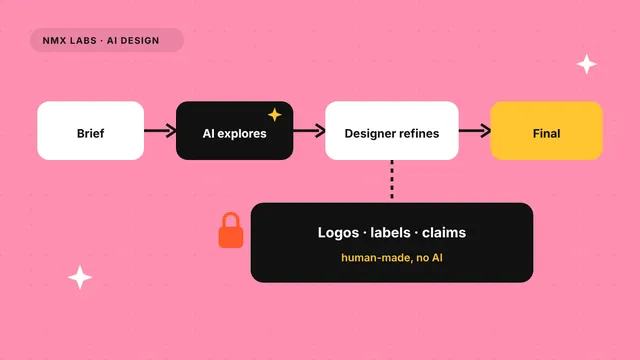
The pattern: generate the world around the product, film the product. Your real packaging, shot on a phone in good light, plus an AI-generated setting, beats a fully generated ad where the bottle changes shape between frames.
Whatever you generate, check how the platform will label it. Meta can add an “AI info” label to ads made or edited with AI, and we covered what triggers it in a separate post9.
We tried it: what a 15-second reel really costs
How we checked this
We built a simple cost model for one 15-second Reel made from two 8-second generated clips, trimmed to fit. The rate is the reported Veo 3.1 Lite price of $0.05 per second at 720p4; check your own tool’s current pricing before relying on it. The keep rates are the variable that matters, so we show three.
| Keep rate | Attempts for 2 usable clips | Generation cost | At ₹88 to the dollar |
|---|---|---|---|
| 1 in 3 | 6 × 8 s = 48 s | $2.40 | about ₹211 |
| 1 in 6 | 12 × 8 s = 96 s | $4.80 | about ₹422 |
| 1 in 10 | 20 × 8 s = 160 s | $8.00 | about ₹704 |
What it shows: even at a poor keep rate, the generation bill for one reel is a few hundred rupees. The real cost is the person reviewing 20 clips, writing better prompts, and editing the keepers together. At a ₹500-an-hour freelance rate, two hours of review already costs more than the worst case above.
The formula, for your own tool: cost per reel = clips needed × clip length × price per second ÷ keep rate. Higher-quality tiers multiply the price per second, so the same reel can cost several times more on a flagship model. The exchange rate is an illustrative round number.
A one-afternoon test brief
Before you change your production process, run this test on one real product. It takes about four hours and tells you more than any comparison article, including this one.
- Pick one existing ad that performed well, so you have a benchmark.
- Write three shot prompts for B-roll only: setting, texture and one transition. Keep the product out of them.
- Generate each prompt in two tools, with the same reference image, and log attempts until you have one keeper per shot.
- Film the product yourself against a plain background, then cut a new version of the ad that mixes your footage with the AI shots.
- Run both versions as a small split test on Meta with the same budget and audience for a week.
- Record four numbers: attempts per keeper, total minutes spent, generation cost, and the test result. Those four tell you whether AI video belongs in your process.
When we publish our own results from this protocol, they’ll go into this post with screenshots and dates, as our editorial standards require.
So which should a small brand use?
| If you… | Start with | Why |
|---|---|---|
| Already pay for Creative Cloud or Firefly | Firefly’s own video model | Clearest commercial terms of the options here67 |
| Want the most realistic short clips for social | Veo 3.1, or Lite for volume | Actively developed, with a cheaper tier for drafts12 |
| Want to compare several models in one place | A multi-model app, Firefly included | But check which model made each clip before publishing6 |
| Need a guaranteed look every month | A real shoot, with AI only for backgrounds | Models change and disappear5 |
The bottom line
Generative video is genuinely useful for small brands, just not in the way the demos suggest. It’s a cheap, fast source of B-roll, settings and transitions around a product you filmed yourself. It isn’t a replacement for your packaging, your people or your claims. And as Sora’s shutdown showed, it isn’t a supplier you can depend on forever. Build the workflow so that the model is replaceable, and the brand isn’t.
Notes and sources
- Google Cloud, Vertex AI documentation: Veo 3.1 model page (release dates for Veo 3.1 and Veo 3.1 Lite) ↩
- Business Standard, 1 April 2026: Google releases Veo 3.1 Lite video generation model ↩
- Decrypt: Google unveils Veo 3.1 to rival OpenAI’s Sora 2 (launch pricing comparison) ↩
- WaveSpeed AI: AI video generation news 2026 (Sora shutdown dates; reported Veo 3.1 Lite rate) ↩
- Tech Insider: Sora 2 vs Veo 3.1 vs Kling 3.0, full comparison (shutdown notice, reference images, Kling 3.0 release) ↩
- TechJunkie: Best AI video generators in 2026, features, pricing and commercial use (Firefly model vs partner models) ↩
- Photutorial: Best AI video generators for commercial use (Firefly indemnity; Sora status) ↩
- NMX Labs: Latest Adobe AI updates, November 2026 (Firefly’s partner models) ↩
- NMX Labs: AI in your Meta ads, the “AI info” label and what it means ↩
Image credits
- *1 Hero illustration: original artwork by NMX Labs.
- *2 Infographic: original artwork by NMX Labs, using the figures cited in the notes. You may reuse it with a link to this page.
- *3 Google logo, a trademark of Google LLC, shown for identification only. Image: Simple Icons (simpleicons.org), brand icon, loaded from cdn.simpleicons.org.
- *4 Adobe logo, a trademark of Adobe Inc., shown for identification only. Image: Simple Icons (simpleicons.org), brand icon, loaded from cdn.simpleicons.org.
Related reading
 AI designAI in your Meta ads: the “AI info” label, automatic enhancements and what the new terms mean
 AI designCanva vs Figma vs Adobe: the AI design war, and which side a brand team should pick
 Adobe · Most readLatest Adobe AI updates, 21 November 2026: what’s live, what’s beta, and what changed since MAX
- Watch on YouTubeVideo explainers: Veo vs Firefly video ads
More from Neeraj, or browse every AI design post.



Comments
Questions, corrections or your own experience with this? Add it below. We read every comment and publish it after a quick check for spam.