Google’s November 2026 core update: the calm person’s guide (it’s also Black Friday)
Google started its third core update of the year on 10 November, right before the biggest shopping week of the year. Rankings wobble during a rollout, and most of the advice you’ll read this week will make it worse. Here’s what to check, when, and what to leave alone.
Key takeaways
- Google began rolling out its November 2026 core update on 10 November, for all sites and languages, and said it could take up to two weeks. It’s the third core update of 2026.
- Don’t judge anything mid-rollout. Google’s advice is to wait until it finishes, then compare a full week afterwards with a week before it started.
- Separate two problems: a ranking drop (your position fell) and a click drop (you rank the same but an AI Overview answers the question). They need different fixes.
- A core update isn’t a penalty. Improve the pages that lost ground for real readers, and ignore anyone selling a guaranteed “recovery” mid-rollout.
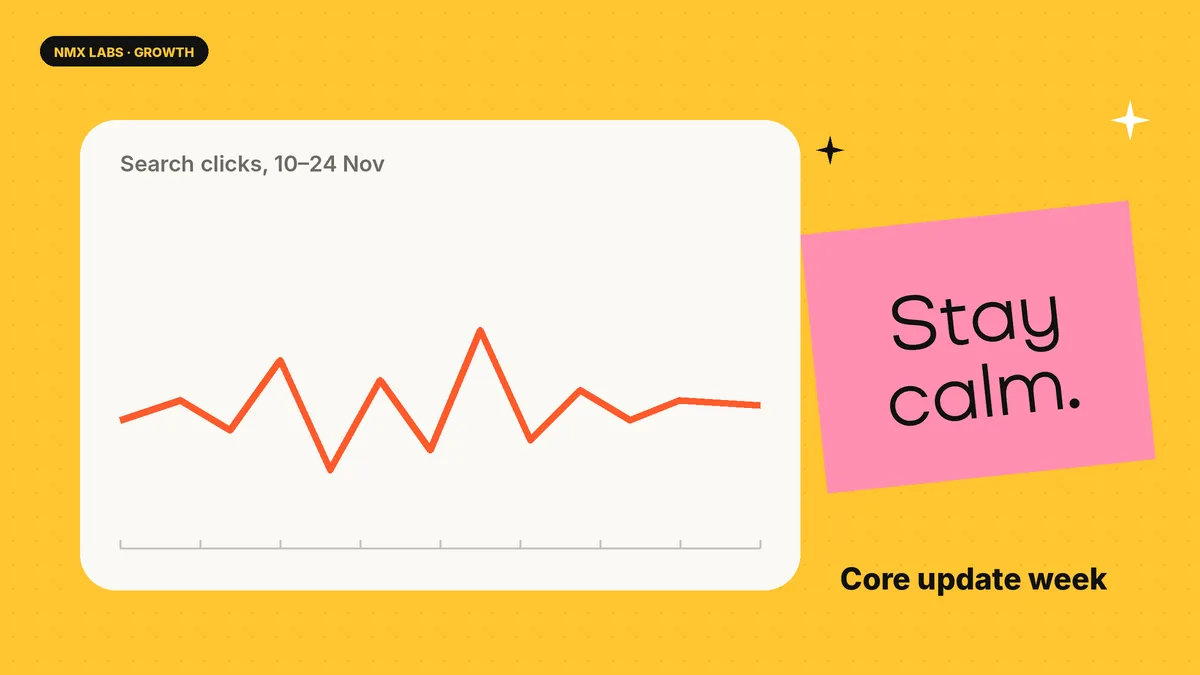
Happy Black Friday. Google would like you to know that your rankings may move around a bit this week. It’s a regular update. Nothing to worry about. Totally normal timing.
I’m being slightly unfair; Google doesn’t plan core updates around retail calendars. But if you run a brand site and your traffic is twitchy right now, here’s the calm version of what’s happening and what to do about it.
What Google actually said
Google started the November 2026 core update on 10 November, at 10:06 Pacific time, according to its Search Status Dashboard. It applies globally, to all languages, and Google said the rollout “may take up to two weeks”1. Its description is the usual one-liner: a regular update designed to better surface relevant, satisfying content2.
It’s the third core update of 2026, after March and May3, and it came shortly after a September spam update that took nearly two weeks to finish in early October4. Check the Search Status Dashboard for the official completion date; Google adds it to the same incident page when the rollout ends.
What not to do this week
- Don’t rewrite your site mid-rollout. Rankings arrive in waves. Changing pages while things are moving makes it impossible to know what helped.
- Don’t buy a “recovery package”. Nobody can guarantee a fix during a rollout, and Google says effects can take months to settle, sometimes until the next core update3.
- Don’t blame the update for everything. It’s Black Friday week. Seasonality, ad spend and email campaigns all move traffic too.
When and how to measure
Google’s own advice is simple and mostly ignored: wait until the rollout is complete, then wait at least a full week, then compare that week with a week before the rollout began2. In Search Console that means:
- Note the start date (10 November) and the official end date from the dashboard.
- Compare clicks and impressions for the week after the end date against 3 to 9 November.
- Break it down by page, not just site-wide. Core updates rarely hit everything equally.
- Compare like with like. If last year’s same week was Black Friday too, use that as a second check.
Ranking drop or click drop?
This is the bit most reports get wrong, and it matters more in 2026 than ever. There are two very different ways to lose traffic:
| What you see in Search Console | What probably happened | What to do |
|---|---|---|
| Impressions down, average position down | You lost rankings in the update | Improve those pages for readers (see below) |
| Impressions steady, clicks down, position steady | An AI Overview or other feature is answering the question | Make the page worth clicking: original data, tools, depth |
| Everything down on a few pages only | Those pages were overtaken by better ones | Look at what now ranks, honestly |
A click drop with stable rankings isn’t an update problem at all. It’s the zero-click shift we wrote about in Blogging is dead. So why are you still reading this?, and no amount of technical SEO fixes it.
How we checked this
On 24 November 2026 we checked the start time and wording against reports quoting Google’s Search Status Dashboard and Search Central announcement, and the history of 2026 updates against two independent trackers. The rollout hadn’t been marked complete when we wrote this, so we haven’t quoted an end date.
If you did lose ground
A core update isn’t a penalty. It’s Google re-ranking pages it thinks are more useful. So the fix is boring and it works: make the pages that dropped genuinely better for the person searching.
- Read Google’s self-assessment questions on helpful content, and answer them honestly for your weakest pages5.
- Add what only you have: real photos, prices, test results, customer questions, expertise.
- Merge or remove thin pages that exist only to target a keyword.
- Fix technical problems anyway (speed, broken pages, crawl errors), but don’t expect them to undo a core update on their own.
Quick answers
When did the Google November 2026 core update start?
On 10 November 2026, at 10:06 a.m. Pacific time. Google said the rollout applies to all sites and languages and may take up to two weeks to complete.
Is a Google core update a penalty?
No. A core update re-assesses how useful pages are compared with others. Pages can drop because something better now ranks, not because they broke a rule.
How long should I wait to measure a core update?
Until Google marks the rollout complete, then at least one more week. Compare that week with a week before the rollout started, page by page.
The bottom line
Breathe. Note the dates, wait for the rollout to end, then measure properly. Separate ranking drops from AI-answer click drops, because they need different fixes. And if someone emails you this week promising to “recover your rankings”, reply with a link to this post. Or don’t reply at all. That also works.
Notes and sources
- Search Engine Roundtable, 10 November 2026: Google November 2026 core update rolling out ↩
- Search Engine Journal, 10 November 2026: Google’s November 2026 core update starts rolling out ↩
- Keywords Everywhere: November 2026 core update rollout tracker (2026 update history; effects can take months) ↩
- Optimixed: Google completes its September 2026 spam update (8 October) ↩
- Google Search Central: Creating helpful, reliable, people-first content (self-assessment questions) ↩
Image credits
- *1 Hero illustration: original artwork by NMX Labs. No brand logos are reproduced.
Related reading
 Growth playbookBlogging is dead. So why are you still reading this?
 Meta adsHow much should an Indian startup spend on Meta ads? A budget guide with the maths
 BrandingThe startup branding checklist: what to have ready before you launch
- Watch on YouTubeVideo explainers: Google November 2026 core update
More from Neeraj, or browse every Growth playbook post.

Comments
Questions, corrections or your own experience with this? Add it below. We read every comment and publish it after a quick check for spam.