10-minute food: Zepto Cafe vs Swiggy Bolt vs Blinkit Bistro, and why only one model is still growing
In December 2024 every quick-commerce app wanted to deliver hot food in ten minutes. Two years later, kitchens have closed, apps have been shut and one model is quietly growing. The difference wasn’t speed. It was who had to cook.
Key takeaways
- There were two models: apps cooking in their own kitchens (Zepto Cafe, Blinkit Bistro, Swiggy Snacc) and Swiggy Bolt, which speeds up existing restaurants near you.
- Own-kitchen models hit staffing and sourcing limits: Zepto Cafe scaled back from a reported 120,000–130,000 daily orders, and Swiggy shut Snacc in February 2026.
- Bolt kept growing because it needs no new kitchens. Swiggy says over 12% of its food orders now go through Bolt, and Bolt-acquired users retain better.
- For brands: speed is a feature, not a positioning. Blinkit kept Bistro as a separate app partly to avoid competing with Zomato’s own restaurant partners.
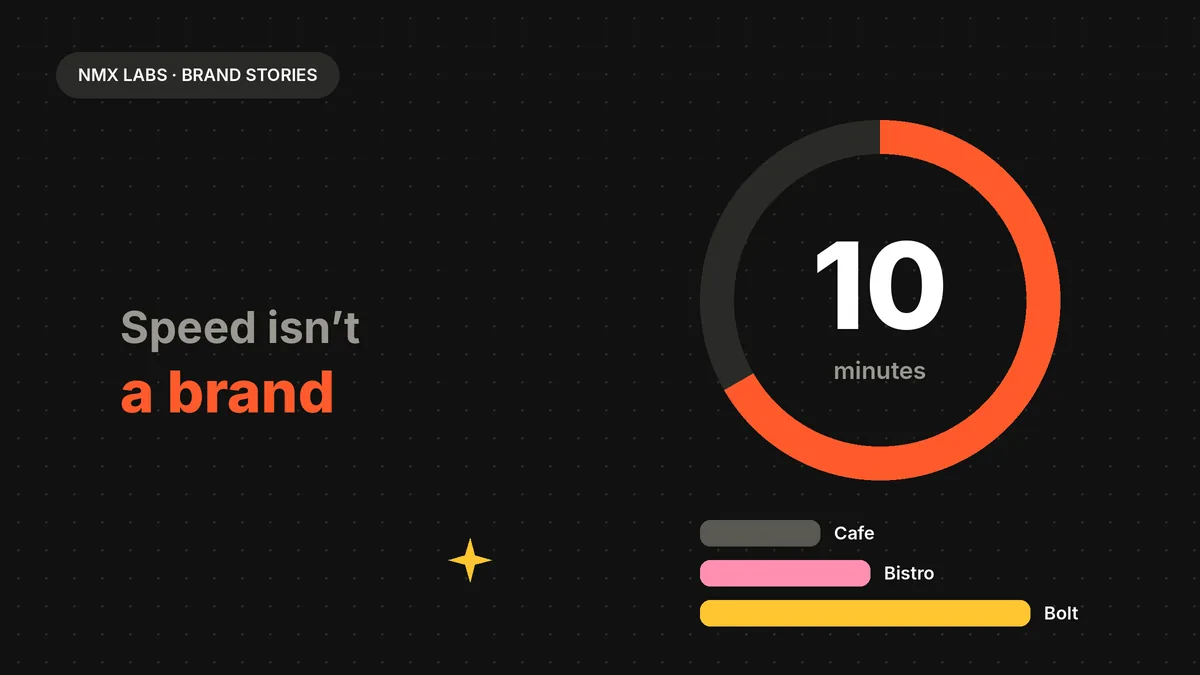
In December 2024, India’s delivery apps briefly agreed on the next big thing: hot food in ten minutes. Zepto launched a separate Zepto Cafe app. A day later Blinkit put out Bistro. Swiggy already had Bolt, and soon added Snacc. Smaller start-ups joined in1211.
By late 2026 the picture looks very different. Zepto Cafe has been scaled back twice, Swiggy has shut Snacc, Zomato dropped its in-app “Quick” service, and one product has kept growing358. This is the story of how that happened, and what it says about speed as a brand promise.


Two very different ways to deliver food in ten minutes
| Own kitchens | Fast restaurants | |
|---|---|---|
| Who | Zepto Cafe, Blinkit Bistro, Swiggy Snacc | Swiggy Bolt |
| Who cooks | The app, in kitchens next to its dark stores1 | Existing restaurant partners, roughly within two kilometres210 |
| Menu | Coffee, snacks, quick meals the app controls | Whatever nearby restaurants can prepare fast |
| What it needs | Kitchen staff, ingredients, equipment, space | Routing and restaurant prioritisation |
| Where it lives | Separate apps, or inside a quick-commerce app | A label inside the existing Swiggy app |
That table explains most of what happened next. The own-kitchen players turned food delivery into a manufacturing business. Swiggy turned it into a sorting problem.
Zepto Cafe: fast growth, then a hard landing
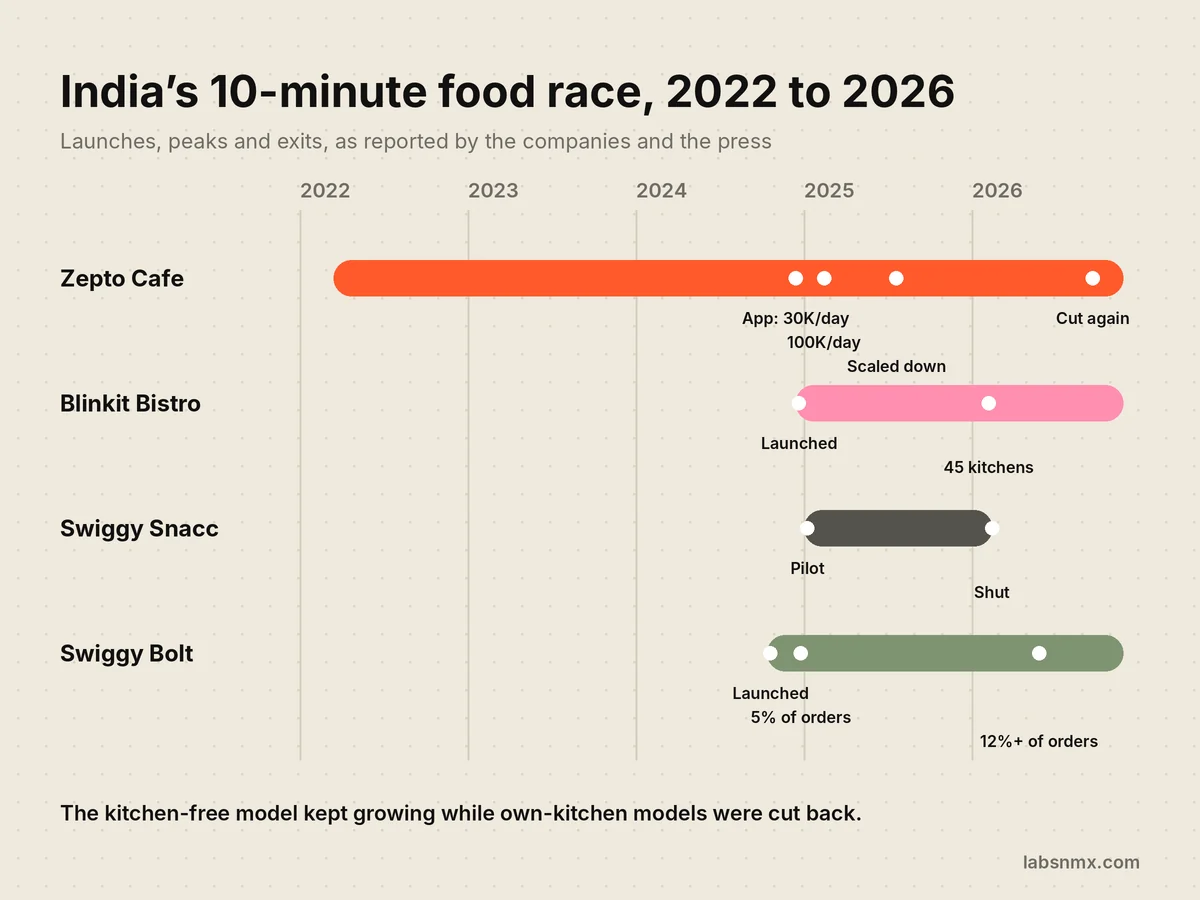
Zepto had run a cafe service inside its app since 2022 and launched a standalone Zepto Cafe app in December 2024, when founder Aadit Palicha said it was opening over 100 cafes a month and doing about 30,000 orders a day1. In February 2025 he posted that it had reached 100,000 orders a day, which he described as close to a $100 million annualised GMV run-rate with a steady-state gross margin of nearly 50%3.
It didn’t last. By July 2025 the company had scaled the service down, citing sourcing problems and a shortage of trained kitchen staff. Average daily orders in May and June were reported at 65,000 to 67,000, against a peak of around 120,000 to 130,000, and the service had stopped in 44 of the roughly 1,000 stores that offered it4. In September 2026 Business Standard reported a further cut to its city footprint and menu, and noted that Zepto’s IPO prospectus didn’t disclose any Cafe metrics3.
Blinkit Bistro: a separate brand for a reason
Blinkit’s Bistro is the most interesting brand decision of the three. Blinkit chief Albinder Dhindsa said Zomato would never launch private brands on its main app to compete with its restaurant partners, which is why Bistro launched as a separate Blinkit app rather than inside Zomato2. It’s the same house-of-brands thinking we wrote about in our Eternal post: keep a new business that competes with your partners under a different name.
Inside the Zomato app, the company shut its own 10-minute “Quick” service, saying restaurant density and kitchen set-ups weren’t ready to deliver in ten minutes8. Bistro carried on, more slowly: by February 2026 it was running 45 kitchens across Delhi NCR and Bengaluru5.
Swiggy: shut Snacc, kept growing Bolt
Swiggy tried both models. Snacc, its own-kitchen snacking app, began as a pilot in January 2025 and was shut in February 202695. Bolt, launched in October 2024, took the other route: it doesn’t cook anything. It flags restaurants close to you and dishes that need little or no preparation, and prioritises them2.
Bolt grew fast. Within two months of launch it was 5% of Swiggy’s food orders, according to a Swiggy executive1. Swiggy’s investor letter later put it above 10% across more than 500 cities7, and management has since said it’s over 12%, with users first acquired through Bolt showing 4 to 6% higher monthly retention than the platform average6.
We tried it: decoding the numbers
How we checked this
We took the figures companies and reporters published and did the arithmetic they left out. Inputs are from the notes; calculations and the exchange-rate assumption are ours.
| Question | Working | Answer |
|---|---|---|
| What did a Zepto Cafe order average at its peak claim? | $100 million ÷ (100,000 orders × 365 days)3 | About $2.74, or roughly ₹235 at ₹86 to the dollar |
| How far did Zepto Cafe orders fall by mid-2025? | From a reported 120,000–130,000 a day to 65,000–67,0004 | Down roughly 45 to 50% |
| How fast did Bolt’s share grow? | 5% after two months1, over 10%7, over 12%6 | More than doubled while rivals cut back |
What it shows: a roughly ₹235 average order is a coffee-and-snack basket. To be profitable at that size, an own-kitchen model has to run its kitchens very full, all day. Staff shortages and sourcing gaps hit exactly that. Bolt never had to staff a kitchen, so the same small baskets were simply extra orders for restaurants that already existed.
Caveat: Palicha described the business as “closing in on” $100 million, so the real average may have been a little lower. And the exchange rate is our round number for early 2025, not an official conversion.
What this means for brands
1. Speed is a feature, not a positioning
When every app promised ten minutes, ten minutes stopped being a reason to choose one. Swiggy didn’t build a new brand around speed; it added a speed label to the brand people already open. For most businesses, a faster service is better sold as a benefit of the existing brand than as a new one.
2. Don’t make customers download your experiment
Bolt lived inside an app people already had. Cafe, Bistro and Snacc asked people to install something new, which is an expensive ask for a cup of coffee. If you’re testing a new offer, put it where your customers already are.
3. Separate brands are for real conflicts
Bistro’s separate identity made sense because it competes with Zomato’s restaurant partners2. That’s the right reason to create a new brand: a genuine conflict with the parent’s promise, not just novelty.
4. Watch retention, not launch buzz
The number that justified Bolt wasn’t its share of orders. It was that customers who arrived through it stuck around longer6. If your new product brings in people who stay, keep investing. If it brings in people who order once, it’s a promotion with extra steps.
5. For restaurants and food D2C brands
If you sell on delivery apps, design a short menu of items you can prepare in minutes and pack well. Bolt-style programmes reward exactly that. If you sell packaged food, the same idea applies to quick commerce: products that are “ready in ten” at home fit the way these apps now sell.
What to watch in 2027
Three numbers will tell us whether this story has an ending. First, whether Zepto discloses Cafe figures as a listed company, since its prospectus didn’t3. Second, whether Bolt’s share of Swiggy’s food orders keeps climbing past 12%6. Third, whether Bistro grows beyond its 45 kitchens in two regions5. If Bistro expands while Bolt keeps growing, both models will have found a lane. If not, the lesson of 2025 and 2026 will stand: in Indian food delivery, the fastest kitchen is the one somebody else already runs.
The bottom line
India’s 10-minute food race wasn’t won by the fastest kitchen. It was won, so far, by the company that didn’t build one. The own-kitchen models proved there was demand, then ran into the hard parts of cooking at scale. Swiggy Bolt turned speed into a filter on top of restaurants that already existed. For any brand tempted to launch a faster version of itself under a new name, that’s the question to ask first: are you adding a capability, or adding a label to one you already have?
Notes and sources
- BNN Bloomberg (Bloomberg), 20 December 2024: Disruptive 10-minute deliveries spread to India’s food business ↩
- Inc42: Zomato, Swiggy put cafe wars in overdrive (Bolt’s model; why Bistro is a separate app) ↩
- Business Standard, 21 September 2026: Zepto Cafe cuts footprint across cities, scales back menu ↩
- Storyboard18, 16 July 2025: Zepto Cafe scales down operations amid supply-chain issues and staff shortages ↩
- YourStory, February 2026: Swiggy winds down Snacc; Bistro’s kitchen count ↩
- Zerodha, The Daily Brief: Food wars are far from over (Bolt share and retention, quoting Swiggy management) ↩
- Entrepreneur India: Quick commerce keeps India’s food delivery space hot (Bolt share and city count from Swiggy’s investor letter) ↩
- Outlook Business: Zomato, Zepto walk away from 10-minute food delivery; Swiggy still betting big ↩
- Inc42: Swiggy pulls the plug on 15-minute food delivery service Snacc ↩
- Kotak Neo, 20 February 2026: Swiggy shuts down Snacc as 15-minute food delivery hits a roadblock (Bolt’s radius) ↩
- Business Standard topic page, December 2024: Race for instant food heats up, Blinkit launches Bistro to rival Zepto Cafe ↩
Image credits
- *1 Hero illustration: original artwork by NMX Labs.
- *2 Infographic: original artwork by NMX Labs, using the figures cited in the notes. You may reuse it with a link to this page.
- *3 Swiggy logo, a trademark of Swiggy Ltd, shown for identification only. Image: Wikipedia, file “Swiggy logo.svg”, loaded from en.wikipedia.org.
- *4 Blinkit logo, a trademark of Eternal Ltd, shown for identification only. Image: Simple Icons (simpleicons.org), brand icon, loaded from cdn.simpleicons.org.
Related reading
 Brand storiesThe 10-minute war: how Blinkit, Zepto and Instamart are fighting with brand, not just dark stores
 Brand storiesWhy Zomato renamed itself Eternal: the house-of-brands bet behind India’s best-known food app
 Brand storiesSwiggy vs Zomato: the push-notification copy war, and why brand voice beats discounts
- Watch on YouTubeVideo explainers: Zepto Cafe vs Swiggy Bolt vs Blinkit Bistro
More from Anisha, or browse every Brand stories post.
Comments
Questions, corrections or your own experience with this? Add it below. We read every comment and publish it after a quick check for spam.