The “finished brand” is dead (allegedly): Docker, FutureBrand and rebranding for AI
In one week Docker swapped its box-carrying whale for “Run on Trust” and FutureBrand declared the static identity system over. Strip away the conference talk and there’s a real shift underneath: your brand now has to be readable by machines. Here’s what that means, with a checklist.
Key takeaways
- Docker’s new identity (19 November 2026) keeps a simplified whale, drops the containers, adds a new signature blue, #6172FF, and replaces “Build, Ship, Run” with “Run on Trust”.
- FutureBrand argues static identity systems can’t keep up when AI makes more of a brand’s output, and proposes designing brand “behaviour” instead.
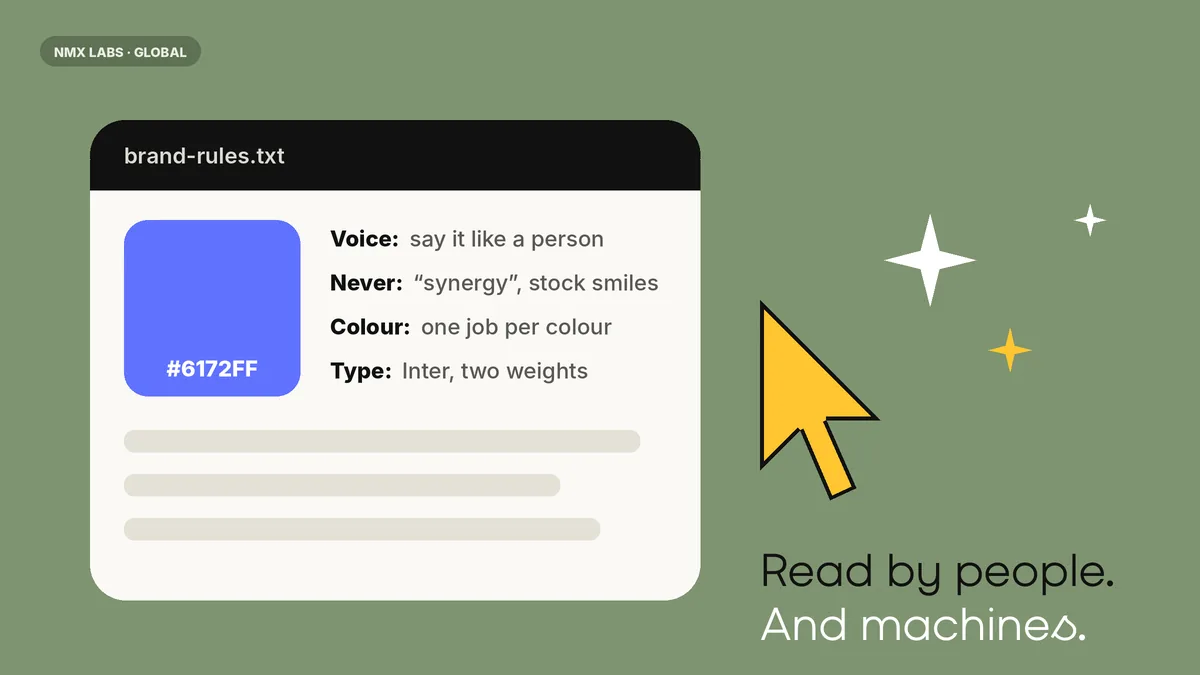
- The practical shift: your guidelines will be read by AI tools, so they need written rules for judgement, voice examples and colour values, not just a logo PDF.
- Sameness is the risk. If every brand in a category feeds AI the same safe rules, everything starts to look alike, which is already happening in electric cars.
Rebrand season usually arrives with a launch film, a manifesto and at least one person on LinkedIn saying the old logo was better. This November had all of that, but underneath the usual noise something genuinely changed. Two very different companies said the same thing in the same week: a brand is no longer just what people see. It’s what machines make in your name.
Docker: when the logo describes the old job
On 19 November Docker unveiled a new identity1. For anyone who’s never typed docker run: Docker’s whale used to carry a stack of shipping containers on its back, because containers were the product. The new mark keeps a simplified whale and adds a containment symbol instead. The signature blue moves from #2496ED to a new “Base Blue”, #6172FF. The old line “Build, Ship, Run” becomes “Run on Trust”, and the audience widens from developers to enterprises and people building AI agents1.
This is a rebrand done for the right reason. The company’s job changed, from packaging software to running it (and increasingly AI agents) safely. When your logo literally illustrates the old job, it has to go. Keeping the whale is the smart bit: you change the story without throwing away fifteen years of recognition.
FutureBrand: the end of the finished brand
A day earlier, on 18 November, the agency FutureBrand relaunched itself with a bigger claim2. Its argument: the industry’s standard model, the brand as a static identity system, a kit of parts with rules, can’t keep up now that brands appear in more places than ever and more of their output is generated by AI. Its answer is designing “brand behaviour”: how a brand looks, moves, talks and sounds, and increasingly how an AI trained on it makes decisions. The report is called From Artefact to Infinite: The End of the Finished Brand2.
Is some of that an agency selling its next service? Of course. Agencies relaunching themselves are contractually obliged to announce the end of something. But the core point is hard to argue with.
The real shift: brands read by machines
Think about who makes your brand’s stuff in 2026. Designers, yes. But also Canva templates, Firefly, ChatGPT drafting your captions, an agency’s AI pipeline producing forty ad variants for Meta. At MAX this month, Adobe even showed outside AI agents editing Photoshop and Illustrator files directly3.
Every one of those tools is guessing what your brand is from whatever you’ve given it. A logo PDF and a hex code don’t tell a machine how to make a judgement call. A good brand book written for humans relies on taste and context. Machines have neither, unless you write it down.
Even design studios are building for this. When London and LA studio How&How renamed itself HOW+HOW this month, its new website was designed to be read by AI search as well as people4.
How we checked this
On 24 November 2026 we compared Docker’s old and new identity details as set out in the company’s own rebrand explainer, and read trade coverage of FutureBrand’s relaunch and report. We haven’t read the full FutureBrand report, so we only describe its argument as reported. The checklist below is ours, from setting up brand systems that AI tools use day to day.
Is your brand AI-ready? A checklist
You don’t need a rebrand to get ready for this. You need a better rulebook. Here’s the one we use with clients:
- Guidelines as text, not just a pretty PDF. AI tools read words. If your rules only exist as images in a deck, they don’t exist for a machine.
- Colour and type as exact values. Hex, RGB and font names, plus which colour does which job. “Our orange is for one thing only” is a rule a tool can follow.
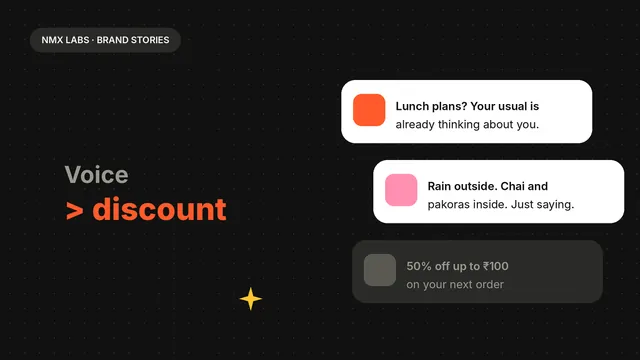
- Voice with examples. Three lines that sound like you, three that don’t, and why. Adjectives like “bold” and “friendly” mean nothing to a model (and not much to people).
- A “never” list. Words you don’t use, imagery you don’t want, competitors you don’t mention. Machines are excellent at following a clear no.
- A library of approved work. The fastest way to teach a tool your taste is to show it ten things you loved and ten you rejected.
- A human pass, always. Rules raise the floor. Taste still sets the ceiling.
The catch: everyone starts to look the same
Here’s the risk nobody puts in the launch film. If every brand writes safe, sensible rules and feeds them to the same few AI tools, everything converges on the same safe, sensible look. The studio Koto recently argued that electric car brands already all look alike5. Add AI to that, and “blanding” becomes the default setting.
So the rules that matter most aren’t the safe ones. They’re the odd, specific, slightly stubborn ones that make you you. Write those down first.
Quick answers
What changed in Docker’s 2026 rebrand?
Docker kept a simplified whale but dropped the shipping containers for a containment symbol, changed its signature blue to #6172FF, and replaced “Build, Ship, Run” with “Run on Trust”, reflecting a move towards running software and AI agents securely.
What does “brand behaviour” mean?
It’s FutureBrand’s term for designing how a brand acts across every context: how it looks, moves, talks and sounds, and how an AI trained on it makes decisions, rather than only a fixed kit of logos and rules.
How do you make brand guidelines AI-ready?
Write them as text, give exact colour and type values, show voice with real examples, include a clear “never” list, and keep a library of approved work that tools can learn from, with a human review on everything that ships.
The bottom line
The finished brand isn’t dead. It just has a new reader, and that reader takes everything literally. Write your brand down so a machine can follow it, keep the weird bits that make you recognisable, and never let the tool have the final say. Docker kept its whale. Keep yours.
Notes and sources
- Docker on DEV Community, November 2026: Docker rebrand 2026, new logo, colours and strategy explained ↩
- Design Week, 23 November 2026: The Outline (FutureBrand relaunch and its report) ↩
- Digital Trends, November 2026: Adobe MAX 2026 is all about AI agents ↩
- Creative Boom, 2 November 2026: How&How launches a new name, strategy, visual identity and website ↩
- Creative Boom branding section, 3 November 2026: Koto, “We need to talk about how all electric car brands look the same” ↩
Image credits
- *1 Hero illustration: original artwork by NMX Labs. No brand logos are reproduced.
Related reading
 BrandingWhat goes in brand guidelines, and how to keep them short enough that people use them
 AI designCanva vs Figma vs Adobe: the AI design war, and which side a brand team should pick
 BrandingCustom brand typefaces in India: why apps commission their own fonts
- Watch on YouTubeVideo explainers: Docker rebrand 2026
More from Neeraj, or browse every Global post.

Comments
Questions, corrections or your own experience with this? Add it below. We read every comment and publish it after a quick check for spam.