Blogging is dead. So why are you still reading this?
Two-thirds of Google searches now end without a click, and AI answers have eaten the “what is” article whole. We went through the studies. Generic blogs are dying. Blogs with a person, a test and an opinion behind them are doing fine, and the difference is learnable.
Key takeaways
- When Google shows an AI summary, people click a normal result 8% of the time instead of 15%, and about 68% of US Google searches now end with no click at all.
- What died is the generic article: definitions, reworded listicles and posts written for search engines rather than people. AI answers those for free.
- What still gets read has something a summary can’t copy: a real test, a number someone measured, a named person with an opinion, or curation you trust.
- The fix for a brand blog is fewer glossary posts, more first-hand work, an owned audience (email and notifications), and measuring mentions and branded search, not just clicks.
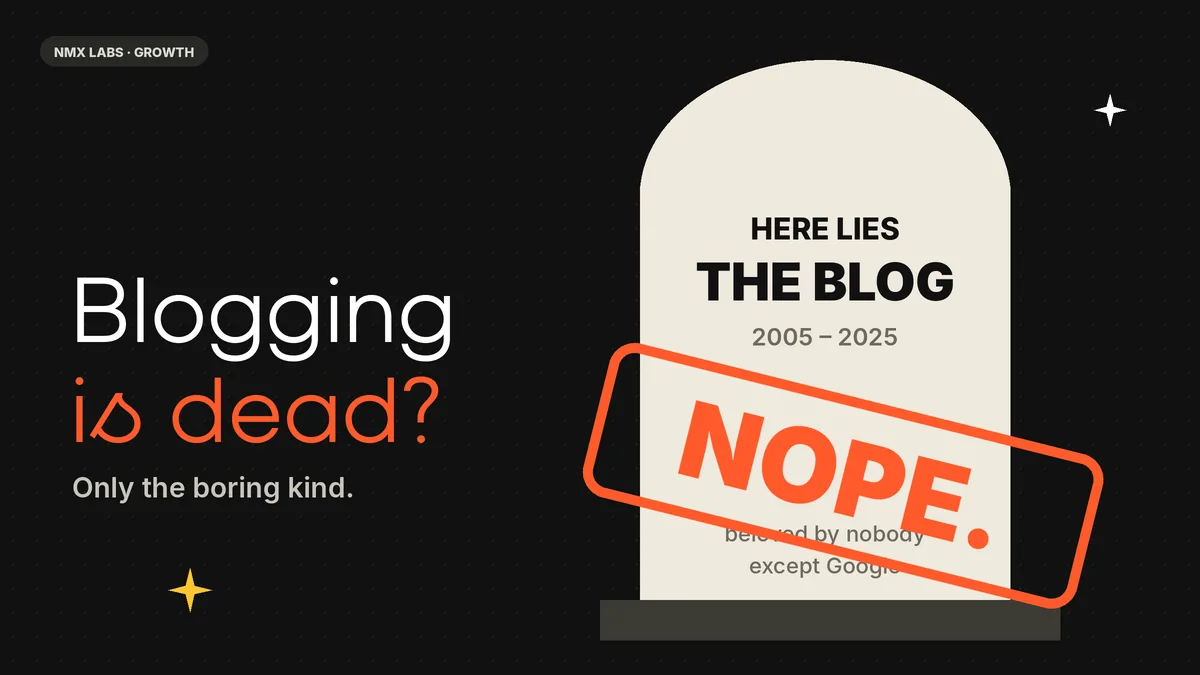
Every few months someone on LinkedIn announces that blogging is dead. Usually in a 1,400-word post. With subheadings. I’ve read most of these eulogies, and I’ll admit the patient doesn’t look great. But I run a studio that publishes three to four articles a week, so I have what you might call a personal interest in the diagnosis.
So I did the boring thing and read the studies instead of the hot takes. Short version: a lot of blogging is dead. Just not the kind you’re reading right now. Probably.
The numbers aren’t pretty
Let’s get the bad news out of the way, because there’s a lot of it.
- AI summaries halve the clicks. Pew Research Center found that when Google shows an AI summary, people click a traditional search result on 8% of visits, against 15% when there’s no summary1.
- Most searches end on Google. SparkToro’s study of a Similarweb panel found 68% of US Google searches between January and April 2026 ended without a click to anywhere, up from about 60% in 20242.
- Ranking first isn’t what it was. Ahrefs measured a 58% lower click-through rate for the top-ranked page on keywords that show an AI Overview, using December 2025 data3.
- Small publishers are hit hardest. Chartbeat data reported by the Reuters Institute showed publisher traffic from Google search down about a third in a year, with small publishers losing far more than the largest ones4.
If your content strategy was “write 40 posts answering beginner questions and wait for Google”, I have bad news and I’m sorry. That strategy now mostly feeds the AI that answers the question for you.
So what actually died?
Not blogging. A specific kind of article. Here’s how I sort it, and it’s the same split we use to plan our own calendar:
| Type of post | Example | Chance in 2026 |
|---|---|---|
| Generic information | What is Adobe Firefly? | Low. AI answers it in one paragraph. |
| Practical guidance | How to use Firefly for product photos | Decent, if you show real steps and screenshots. |
| Original work | We tested Firefly on 20 product images | Best. Nobody else has your results. |
The “what is” post was always a bit of a hustle. You wrote it because people searched for it, not because you had anything to add. AI didn’t kill those posts so much as call their bluff.
Why people still read some blogs
Here’s the part the eulogies skip. People haven’t stopped reading. They’ve stopped reading things that could have been written by anyone. Four things still pull people in, and none of them is a keyword.
1. A person with a point of view
An AI answer is, by design, the average of what’s out there. Useful, polite and slightly beige. People come to a named writer for the opposite: a take, a strong preference, the occasional “honestly, don’t bother”. You can’t average your way to an opinion.
2. Proof you can’t get from a summary
A test with screenshots. A cost you actually paid. A before-and-after from real client work. Google’s own guidance on helpful content asks whether a page shows first-hand experience and original research, and those are precisely the things a summary has to borrow from somebody5.
3. Taste
There’s more content than ever and less time to read it. Somebody you trust filtering the noise (this week’s three rebrands worth your attention, not the 40 that aren’t) is a service. It’s why our news page exists.
4. A relationship Google can’t switch off
Google can change its algorithm on a Tuesday. It can’t take away the readers who chose to get your posts by email or notification. And when people search for you by name, things look better: Amsive found branded searches that show an AI Overview actually got more clicks, not fewer6. Being someone people look for on purpose is the best SEO there is.
How we checked this
On 24 November 2026 we read the studies cited here and compared how each one measures things, because they don’t measure the same thing. Pew and SparkToro follow real people’s searches through panels; Ahrefs and Seer look at click-through rates on tracked keywords; Chartbeat counts referrals to publisher sites. Different methods, same direction: fewer clicks from Google, especially for generic information. We didn’t run our own traffic experiment for this post, and we’re not pretending we did.
The rules we now write by
This is the bit where I tell you how we run the NMX Labs blog, partly so you can steal it and partly so you can hold us to it.
- Every post needs something a summary can’t copy. A test, a number we measured, a decision we’d defend, or a story from actual client work. No exceptions, no “ultimate guides”.
- Answer first, then earn the scroll. Key takeaways at the top, so a busy reader (or an AI engine looking for something to quote) gets the point in ten seconds.
- Name every source. Numbered notes, linked. If we can’t source it, it doesn’t go in.
- Write like a person. If a sentence could appear on any company’s blog, we rewrite it until it couldn’t.
- Three to four posts a week, never filler. Consistency builds the habit; filler kills it faster.
What to do with your brand’s blog
If you run marketing for a brand, in London, New York or Gurugram, here’s the practical version:
- Stop commissioning glossary posts. If ChatGPT can write it in ten seconds, it isn’t worth paying someone to write it in ten hours.
- Turn your work into content. Every campaign, test and awkward client question is a post nobody else can write.
- Build an owned audience. Email, browser notifications, WhatsApp. Anything where you, not an algorithm, decide who hears from you.
- Measure what matters now. Clicks are only part of it. Watch branded search, newsletter sign-ups and whether AI tools mention you when people ask about your category.
- Make yourself easy to quote. Clear claims, clean structure, sources. Our free short course on getting found in AI answers walks through it.
Quick answers
Is blogging dead in 2026?
No, but generic blogging is. Articles that only restate common knowledge lose most of their clicks to AI answers. Blogs built on first-hand tests, opinions and expertise still earn readers, links and citations.
Do AI Overviews reduce website traffic?
Yes, on average. Pew found people clicked a regular result 8% of the time with an AI summary on the page, against 15% without one, and Ahrefs measured a 58% drop in clicks to the top result on affected keywords.
What kind of blog content still works?
Original research and tests, practical guides with real screenshots and numbers, strong opinions from named experts, and curated round-ups readers trust, ideally delivered by email or notification so you’re not relying on search alone.
The bottom line
Blogging isn’t dead. Blogging as a search-engine side hustle is. If you write things only you could write, and give people a way to hear from you that doesn’t go through Google, you’re fine. Better than fine, actually, because half your competitors just gave up.
Anyway. You made it to the end, which is more than most of the eulogies can say. If you’d like the next one, tap Follow. We post three to four times a week, and I promise at least one of them will annoy somebody.
Notes and sources
- Pew Research Center, July 2025: Google users are less likely to click on links when an AI summary appears (8% vs 15%) ↩
- Summary of SparkToro’s 9 June 2026 zero-click study (Similarweb US panel, January to April 2026: 68.01% of searches with no click) ↩
- Round-up of Ahrefs’ February 2026 AI Overviews study (58% lower CTR for position one) and Seer Interactive’s CTR data ↩
- Same round-up: Reuters Institute and Chartbeat, publisher traffic from Google search down about a third year on year to November 2025 ↩
- Google Search Central: Creating helpful, reliable, people-first content ↩
- Search Engine Journal: AI Overviews’ impact on publishers (Amsive: branded queries with AI Overviews saw an 18% higher click-through rate) ↩
Image credits
- *1 Hero illustration: original artwork by NMX Labs. No brand logos are reproduced.
Related reading
 Meta adsMeta’s Andromeda, explained: why your ad creative now does the targeting
 AI designCanva vs Figma vs Adobe: the AI design war, and which side a brand team should pick
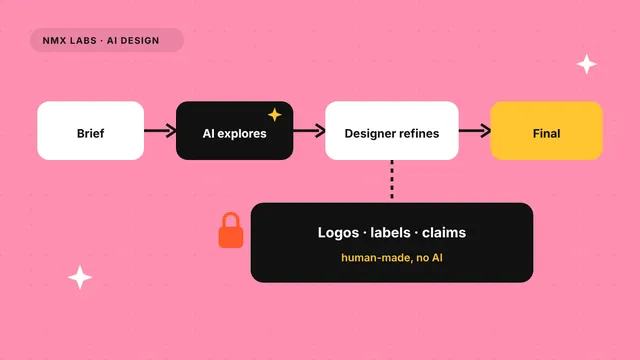 AI designOur AI design workflow: where AI earns its place and where we keep it out
- Watch on YouTubeVideo explainers: is blogging dead AI search 2026
More from Neeraj, or browse every Growth playbook post.

Comments
Questions, corrections or your own experience with this? Add it below. We read every comment and publish it after a quick check for spam.