Our AI design workflow: where AI earns its place and where we keep it out
We use AI on almost every project, and on almost no final pixels of a logo or a label. Here’s the exact workflow, step by step, including the checks that catch the mistakes AI makes confidently.
Quick summary
- A person writes the brief; AI helps explore directions, not decide strategy.
- Final creative is rebuilt with the real product, the master logo and live type, in layered files.
- AI comes back for repetitive production: extensions, cleanup, upscaling and variations.
- Every asset passes a checklist for product accuracy, text, claims, anatomy and safe zones before it ships.
Summary by Anisha. Prefer an AI take? Ask Google AI to summarise it (opens in a new tab).
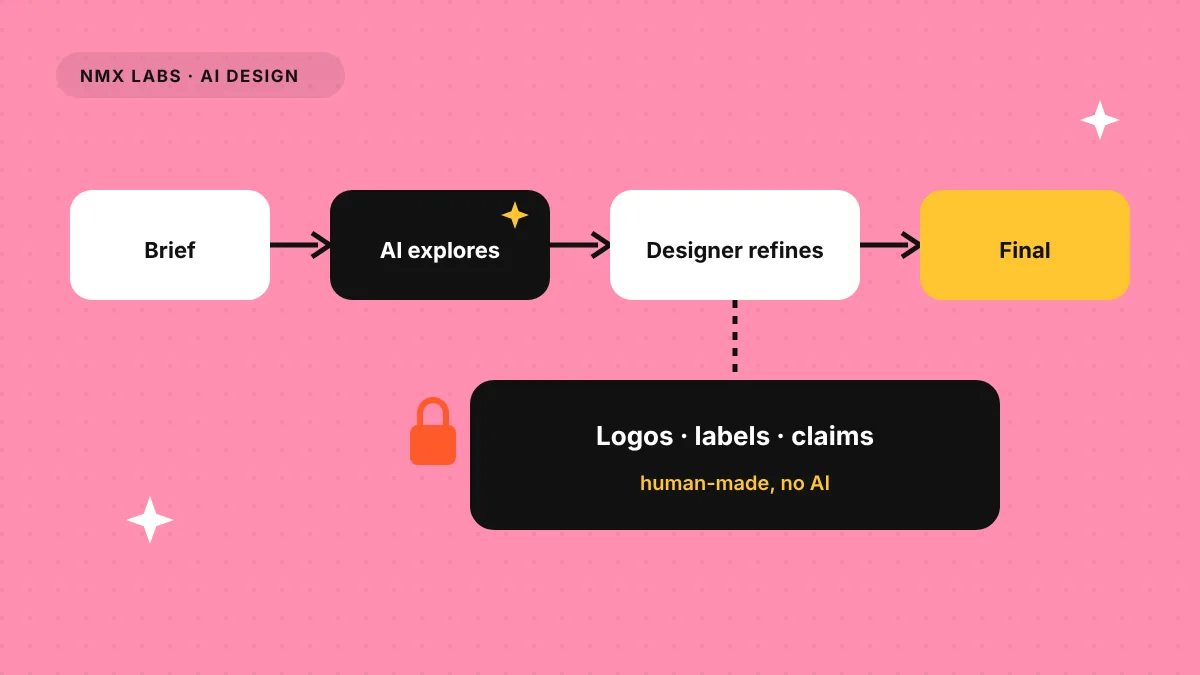
Clients ask us two opposite questions about AI. Half want to know whether we use it, because they’ve heard it makes everything cheaper. The other half want to know whether we use it, because they’re worried their brand will end up looking like everyone else’s. Both are fair. The honest answer is that we use AI heavily in the middle of the process and keep it away from the start and the end.
This is the workflow we run on social and campaign creative today. Tools change monthly; the shape of the process hasn’t changed in a year.
Step 1: The brief is written by a person
Every project starts with a one-page brief: who the ad is for, the single thing they should believe after seeing it, the proof, the offer, and the mandatory elements (price, disclaimers, logo lock-ups). AI tools are good at expanding ideas and bad at choosing between them. If the brief is vague, AI will happily give you forty polished versions of the wrong idea.
We sometimes use an assistant to stress-test a brief (“what objections would a first-time buyer in a tier-2 city have?”), but a human makes the call on the strategy.
Step 2: Exploration is where AI saves the most time
Once the idea is locked, we explore how it could look. This used to mean an afternoon on Pinterest and a mood board. Now we generate wide: lighting setups, compositions, colour moods, backgrounds, props, styling for the product’s world. We’re not looking for a final image here. We’re looking for a direction, quickly, and for the client to react to options rather than to descriptions.
Two rules at this stage:
- Generate with references, not just words. Feed the brand’s existing imagery, palette and past winning ads as style references. Text-only prompts drift toward the generic look every other brand is getting.
- Show the client directions, not finals. Label exploration as exploration so nobody falls in love with an image that can’t be produced to spec.
Step 3: Build with real assets, not generated ones
This is the step that separates brand work from AI slop. When a direction is approved, we rebuild it properly in Photoshop, Illustrator or After Effects:
- The product is always the real product. We composite a real packshot into a generated or photographed scene. Image models still invent label text, change bottle shapes and blur ingredients lists. For a consumer brand that’s not a style issue; it can be a misleading-advertising issue.
- The logo is always the master file. Never regenerated, never “close enough”.
- Typography is set by a designer. Headlines, prices and offers are live type, kerned and checked. This matters even more for Hindi and other Indic scripts, where generated text is usually broken.
- Lighting is matched by hand. Relight tools help, but someone has to check that the shadow under the product agrees with the light in the scene.
Every file stays layered. When the client asks for a price change or a new size next week, it’s a five-minute edit rather than a regeneration that never quite matches the original.
Step 4: Use AI for the repetitive production
After the master creative is approved, AI comes back in for the boring, high-volume part: extending backgrounds for new aspect ratios, removing small distractions, upscaling, cleaning audio on video, generating cut-downs and variations of a background for testing. This is the work that used to eat a junior designer’s week. It’s also where Adobe’s newer agent features, announced at MAX 2026, are heading.
Step 5: A checklist before anything ships
AI mistakes are confident mistakes: an extra finger, a reflection that doesn’t match, a word that looks like English from a distance. So every asset goes through the same review before it leaves the studio:
“SGC advertisements remain subject to the full ASCI Code.”
- Product, label and logo match the master files exactly.
- All text is live type and spell-checked, in every language version.
- Prices, offers, dates and disclaimers match the approved copy sheet.
- Hands, faces, reflections and shadows look physically right at 100% zoom.
- Nothing in the image implies a claim the brand can’t support.
- The image doesn’t look like a recognisable person, artwork, character or another brand’s property.
- The asset works at phone size, with text inside the platform’s safe zones.
Where we deliberately keep AI out
Logo design. We may use AI to explore visual territories early on, but marks are drawn by hand. A logo has to be ownable and defensible, and you can’t be confident of either with a generated shape.
Brand strategy and naming decisions. AI is useful for long lists. The decision needs someone who understands the business, the category and the people buying.
Real people. We don’t generate fake customers or fake testimonials. If an ad shows a person using the product, it’s a real person who agreed to be in it.
Disclosure
When an image is substantially AI-generated, we tell the client, and we keep a note of which tools were used. Meta labels some AI-generated content, and rules around disclosure are evolving across platforms. Tools that attach Content Credentials to files make this record easier to keep, so it’s worth switching them on.
What this means for cost
AI has made exploration and production cheaper and faster. It hasn’t made thinking, taste or checking cheaper, and those are the parts that decide whether an ad works. That’s why our pricing is built around outcomes (a set of creatives, a campaign system) rather than hours.
Next: see how this feeds into the way we structure a Meta ads creative system.
Image credits
- *1 Hero illustration and infographics: original artwork by NMX Labs.
Related reading
 AI designAI product photography for D2C brands: what to generate, and what you still need to shoot
 AI designAI in your Meta ads: the “AI info” label, automatic enhancements and what the new terms mean
 Adobe · Most readLatest Adobe AI updates, 21 November 2026: what’s live, what’s beta, and what changed since MAX
- Watch on YouTubeVideo explainers: AI design workflow for brand designers
More from Anisha, our market research lead, or browse every AI design post.
Comments
Questions, corrections or your own experience with this? Add it below. We read every comment and publish it after a quick check for spam.