Swiggy vs Zomato: the push-notification copy war, and why brand voice beats discounts
Any food app can match a coupon by lunchtime. Nobody can copy a voice. Here’s how India’s two delivery apps turned the most ignored channel on your phone into a brand asset, where rivals got it badly wrong, and a copy test we ran on real notifications.
Key takeaways
- A discount can be matched the same day. A recognisable voice can’t, which is why India’s biggest food apps treat notifications as a brand channel.
- Zomato’s voice came from a one-line brief to a young in-house team, according to its founder. Swiggy’s leans on personalisation built from customers’ own orders.
- The worst Indian notification mistakes failed on honesty or sensitivity, not on wit: a contraceptive that “misses you”, a fake missed-call alert, copy that imitates the phone’s own alerts.
- For smaller brands: a one-line voice brief, a “never say” list, plain copy for sensitive categories, and measure opt-outs and repeat opens, not just clicks.
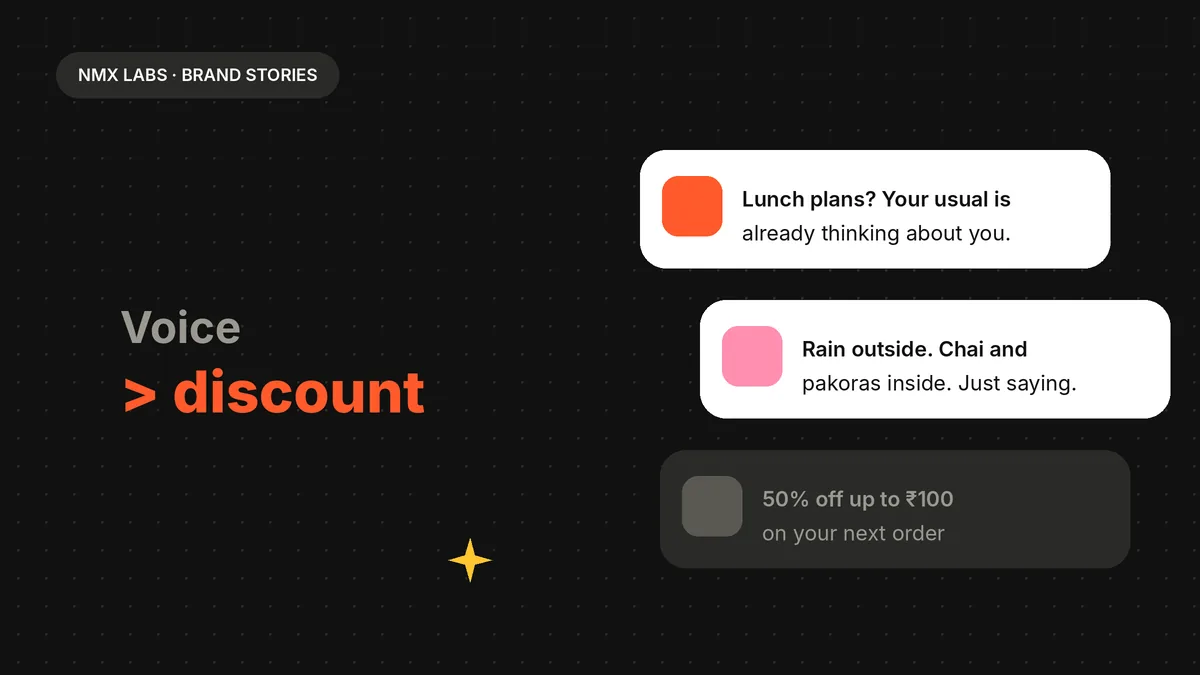
Open your notification shade at 12:40 on a weekday and you’ll find the most crowded ad space in India: two lines of text, usually no picture, squeezed between a bank OTP and a family WhatsApp group. Food apps fight over this space every day, and the two biggest have spent years showing that what they say there matters more than what they discount.
This post looks at how Zomato and Swiggy built recognisable voices in a channel most brands treat as a coupon dispenser, where their rivals embarrassed themselves, and a simple copy test we ran on real, reported notifications that you can run on your own.


Discounts are a parity move. A voice isn’t
A discount is the easiest thing in marketing to copy. If one app offers half off at lunch, the other can match it before dinner, and the customer learns only that both apps are cheap today. Nothing about that exchange belongs to either brand.
A voice works the other way round. Every line that makes someone smile, or screenshot it for a friend, makes the next notification from the same sender slightly more likely to be opened. It also travels for free: food-app notifications get shared on social media, quoted in the press and, in Zomato’s case, read out on prime-time television1. A rival can match your price in an afternoon. It can’t match two years of lines that people remember as yours.
That doesn’t mean discounts stop working. A discount buys today’s order; a voice buys tomorrow’s open. A growing brand needs both, but only one of them compounds.
Zomato: the friend who texts a little too much
Zomato’s notifications are known for being cheeky, sometimes flirty, and written like a message from someone who knows exactly what you ordered last Friday. In November 2024, founder Deepinder Goyal explained the origin on The Great Indian Kapil Show. He said he had briefed his team on building a personal relationship with customers after reading a book about it, admitted he wasn’t sure himself what that meant, and credited a team he called “very young and passionate” with no formal marketing background1.
Two details matter. The voice came from a single, simple brief, not a 60-page tone-of-voice manual. And it was written by people who use the app the way customers do, which is why it sounds like a person rather than a campaign.
Swiggy: personal because it uses your own data
Swiggy took a different road to the same place. Its best-known communication plays with what it knows about you. Its StatEATstics and “appraisal” mailers turned each customer’s order history into a story about them. When it relaunched its Swiggy SUPER membership with three plans, it sent everyone the same message addressed to one name, “Suryakant”2. Users rushed online to point out the mistake. It wasn’t one: the follow-up explained that, unlike one-size-fits-all memberships, the new plans let each person choose how they save2.
Swiggy’s published brand book, dated July 2026, shows the playful side is still policy. Its sample layouts use pun-led lines in the same family as its app copy, right next to strict rules about how the logo may and may not be used3. A loose, human voice and a strict brand system aren’t opposites. The strict system is what lets the voice stay loose without the brand falling apart.
| Zomato | Swiggy | |
|---|---|---|
| Personality | Cheeky friend, flirty banter | Playful, pun-friendly, data-personal |
| Signature move | One-to-one lines that sound typed for you | Stunts and recaps built on your own orders |
| Where it comes from | A founder’s brief and a young in-house team1 | Personalised mailers and campaigns2, a written brand book3 |
| Biggest risk | Familiarity tipping into creepy | A deliberate “error” that isn’t explained fast |
Our editorial reading of each brand’s public communication, not either company’s own description.
Where the voice goes wrong
The same tools that make a notification feel personal can make it feel invasive. The clearest Indian example is Zepto’s 2024 notification that addressed a customer by name with a line saying an emergency contraceptive brand missed her. She posted it on LinkedIn, it drew thousands of reactions, and Zepto apologised and said it wouldn’t happen again4. The template behind it, “I miss you, says [product]”, is harmless for a snack. Run automatically on a sensitive health product, it read as a stranger commenting on someone’s private life8.
Other mistakes are about honesty rather than taste. Inc42 documented Ola using “8 missed calls from mom” as a headline to promote its quick-commerce service, a line built to cause panic rather than interest5. In September 2025, a user submission to Deceptive Design flagged a Blinkit notification worded like a phone-system alert6. Both probably earned opens. Both also teach people to distrust everything that app sends next, which is the opposite of what a voice is for.
There’s a newer risk: once a voice is famous, people forge it. In June 2026, during the online row over a comedian’s “₹370 biryani date” joke, a fake notification styled like Zomato’s went viral and many people believed it. Zomato said it hadn’t sent it, and replied in its own voice that biryani is dinner, not consent7. The denial landed because the brand already sounded like that. A brand without a recognisable voice has no way to say “that isn’t us” and be believed.
We tried it: a six-point copy test on real notifications
How we checked this
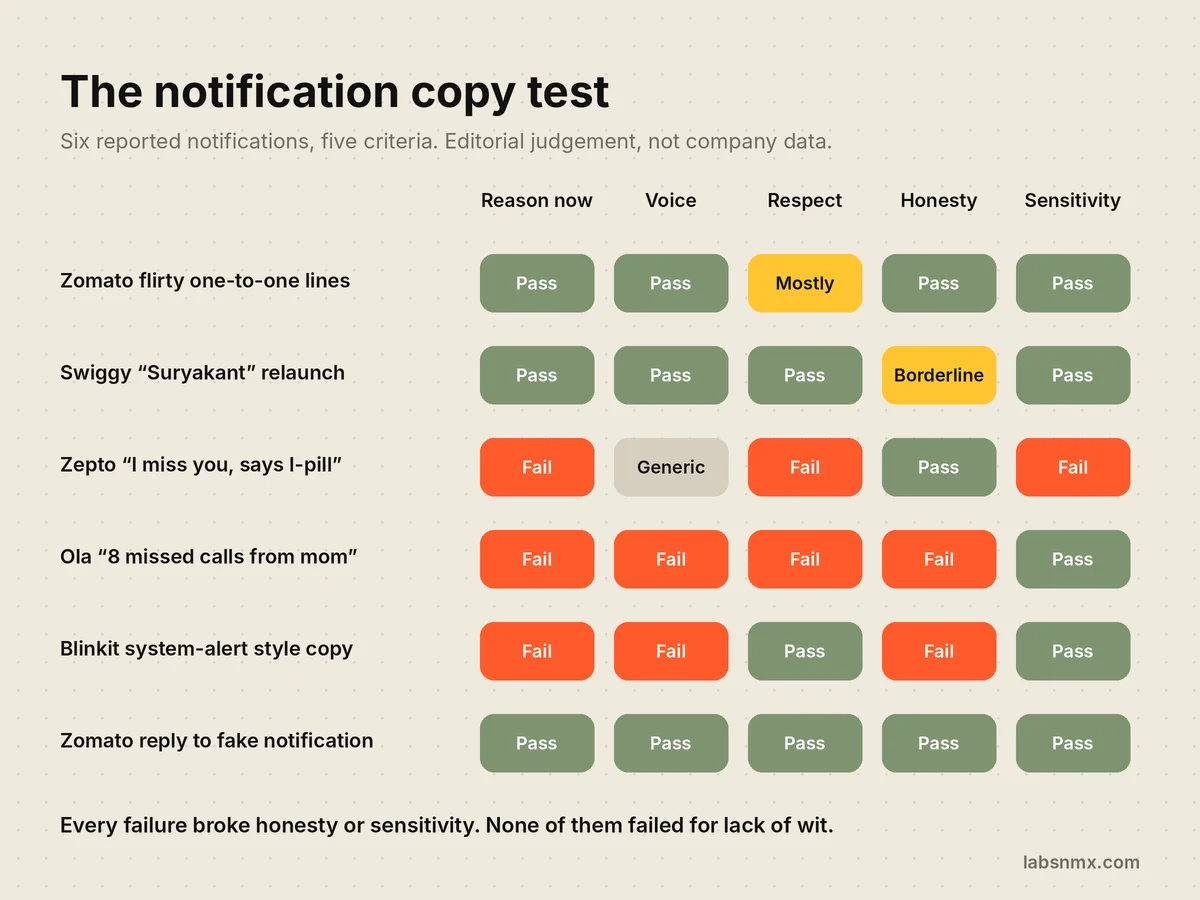
We wrote a short test for notification copy and applied it to six messages reported by the outlets cited in this post. The scores are our editorial judgement from the reported text and context. We had no access to any company’s internal data.
- Reason now: is there a trigger, like time, weather, a match or an order update?
- Voice: would you know the brand with the logo hidden?
- Respect: would it be fine read aloud at the dinner table?
- Honesty: does it avoid imitating a call, an OTP, a system alert or a personal message?
- Sensitivity: does it avoid guessing about health, money or relationships?
| Message (as reported) | Reason now | Voice | Respect | Honesty | Sensitivity |
|---|---|---|---|---|---|
| Zomato’s flirty one-to-one lines1 | Pass | Pass | Mostly | Pass | Pass |
| Swiggy’s “Suryakant” relaunch2 | Pass | Pass | Pass | Borderline | Pass |
| Zepto’s “I miss you, says I-pill”4 | Fail | Generic | Fail | Pass | Fail |
| Ola’s “8 missed calls from mom”5 | Fail | Fail | Fail | Fail | Pass |
| Blinkit’s system-alert style copy6 | Fail | Fail | Pass | Fail | Pass |
| Zomato’s reply to the fake biryani notification7 | Pass | Pass | Pass | Pass | Pass |
What surprised us: none of the failures were failures of wit. Every one broke the honesty or sensitivity rule. The funny lines that worked were funny and clearly from the brand. The ones that backfired were either pretending to be something else, or guessing about something private.
Run it on yours: export last month’s notifications from your CRM or push tool, paste them into a sheet with these five columns, and score them with two colleagues. Anything that fails honesty or sensitivity goes, however well it performed.
A notification voice kit for smaller brands
1. Write a one-line brief, not a manual
Zomato’s started as an idea about a personal relationship1. Yours could be “the friend who knows good coffee” or “the auntie who is never wrong about pickles”. If a writer can’t hold the brief in their head, it won’t show up in two lines of copy.
2. Keep a “we’d never say this” list
Never imitate calls, OTPs, delivery alerts or personal messages. Never guess about pregnancy, illness, money trouble or relationships. Never use family members as bait. Put the list somewhere everyone who can press “send” will see it.
3. Give every send a reason
Weather, time of day, a match, a festival, an order update. A notification with no reason is a reminder that you exist, and those are the first ones people mute.
4. Lock sensitive categories to plain copy
The Zepto mistake was a template problem: a playful formula ran across a category it should never have touched4. If you sell pharmacy, intimate care or financial products, mark those SKUs so that automated campaigns fall back to plain, factual wording.
5. Measure the second open, not just the first
Click-through rate rewards trick headlines. Track opt-outs, uninstalls and repeat opens over a week as well. A line that wins today and costs you next month’s audience isn’t a winner.
6. Publish your voice
When people know how you sound, a forgery is easier to spot, as Zomato found in 20267. A one-page public tone guide, or even a pinned post with your “never say” list, does that job.
The bottom line
Discounts rent attention; voice owns some of it. Zomato and Swiggy show two ways to sound human in two lines of text, and their rivals show the two ways to lose that trust: pretending to be something you’re not, and guessing about things that aren’t your business. For a small brand, the cheapest competitive advantage on a customer’s phone isn’t a bigger coupon. It’s a sentence they’d recognise as yours.
Notes and sources
- Business Today, 8 November 2024: Deepinder Goyal on Zomato’s notifications, on The Great Indian Kapil Show ↩
- afaqs: Why is Swiggy addressing all its users as ‘Suryakant’? (Swiggy SUPER relaunch, StatEATstics and appraisal mailers) ↩
- Swiggy: brand book (PDF, published July 2026) ↩
- Deccan Herald: Zepto faces backlash over ‘Miss you, says I-pill’ notification, issues apology ↩
- Inc42: Ola’s push notification and Flipkart SMS, startups prey on India’s app appetite ↩
- Deceptive Design, 11 September 2025: Blinkit notification using the same copy as system functions (user submission) ↩
- Business Today, 11 June 2026: Zomato clarifies the ₹370 biryani notification was fake ↩
- ThePrint (opinion): push notifications are annoying and intrusive ↩
Image credits
- *1 Hero illustration: original artwork by NMX Labs.
- *2 Infographic: original artwork by NMX Labs, using the figures cited in the notes. You may reuse it with a link to this page.
- *3 Swiggy logo, a trademark of Swiggy Ltd, shown for identification only. Image: Wikipedia, file “Swiggy logo.svg”, loaded from en.wikipedia.org.
- *4 Zomato logo, a trademark of Eternal Ltd, shown for identification only. Image: Simple Icons (simpleicons.org), brand icon, loaded from cdn.simpleicons.org.
Related reading
 Brand storiesAmul made memes before the internet: what 60 years of topical ads teach brand teams about moment marketing
 Brand storiesWhy CRED made Rahul Dravid smash a car mirror: the against-type casting playbook
 Brand storiesWhy Zomato renamed itself Eternal: the house-of-brands bet behind India’s best-known food app
- Watch on YouTubeVideo explainers: Zomato Swiggy push notification marketing
More from Anisha, or browse every Brand stories post.
Comments
Questions, corrections or your own experience with this? Add it below. We read every comment and publish it after a quick check for spam.