How we build a Meta ads creative system instead of a batch of ads
Most brands brief Meta creative one ad at a time. Then they can’t tell why anything worked. This is the system we use to make creative testable, repeatable and cheaper to refresh.
Quick summary
- Treat Meta creative as a grid of angles, hooks and formats, not a folder of one-off ads.
- Name every ad Angle_Hook_Format_Size_Version so reports show what actually worked.
- Design 4:5 for Feed and 9:16 for Stories and Reels, and keep text out of the safe zones.
- Test three to five concepts at a time, judge after meaningful spend, and iterate on winning angles.
Summary by Neeraj. Prefer an AI take? Ask Google AI to summarise it (opens in a new tab).
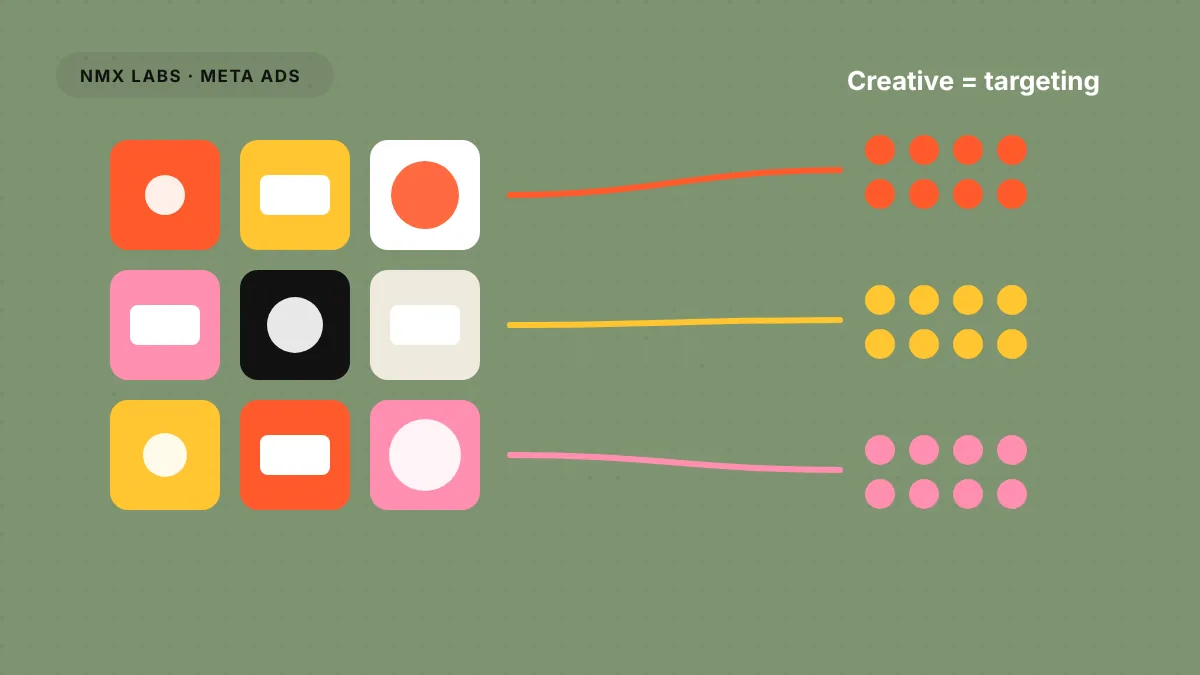
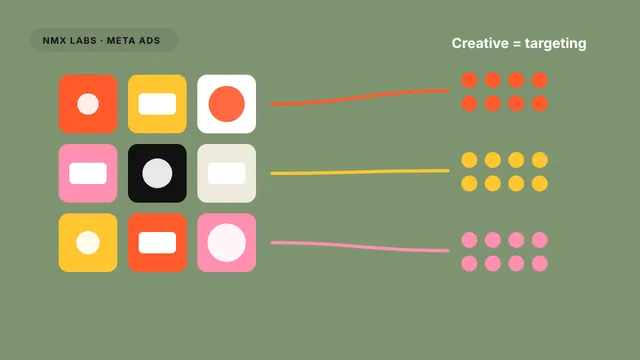
On Meta, creative is targeting. With broad audiences and Advantage+ placements doing more of the work, the main lever you still control is what people see. That’s why we treat ad creative as a system with parts you can swap and measure, not as a folder of nice-looking images.
“…better performance automatically from the retrieval system matching ads across a larger candidate pool”
The three building blocks: angle, hook, format
Every ad we make is a combination of three things, and we name them separately so we can learn from each.
Angle: why someone should care
An angle is the reason to buy, framed for one type of person. For a skincare brand that might be ingredients (“no fragrance, no alcohol”), problem (“tanning that won’t fade”), social proof (“10,000 reviews”), price (“less than ₹15 a day”) or comparison (“vs. the salon”). We usually start a brand with four to six angles drawn from reviews, sales calls and the founder’s own pitch.
Hook: the first second
The hook is what stops the scroll: the opening frame of a video, or the headline and image of a static. The same angle can have many hooks. A question, a bold claim, a before/after, a face talking to camera, a product in an unexpected place.
Format: how the message is delivered
Static image, carousel, short video, UGC-style video, motion graphic, founder video. Formats behave differently: a carousel can explain a comparison; a nine-second video can show a texture; a static can carry a hard offer.
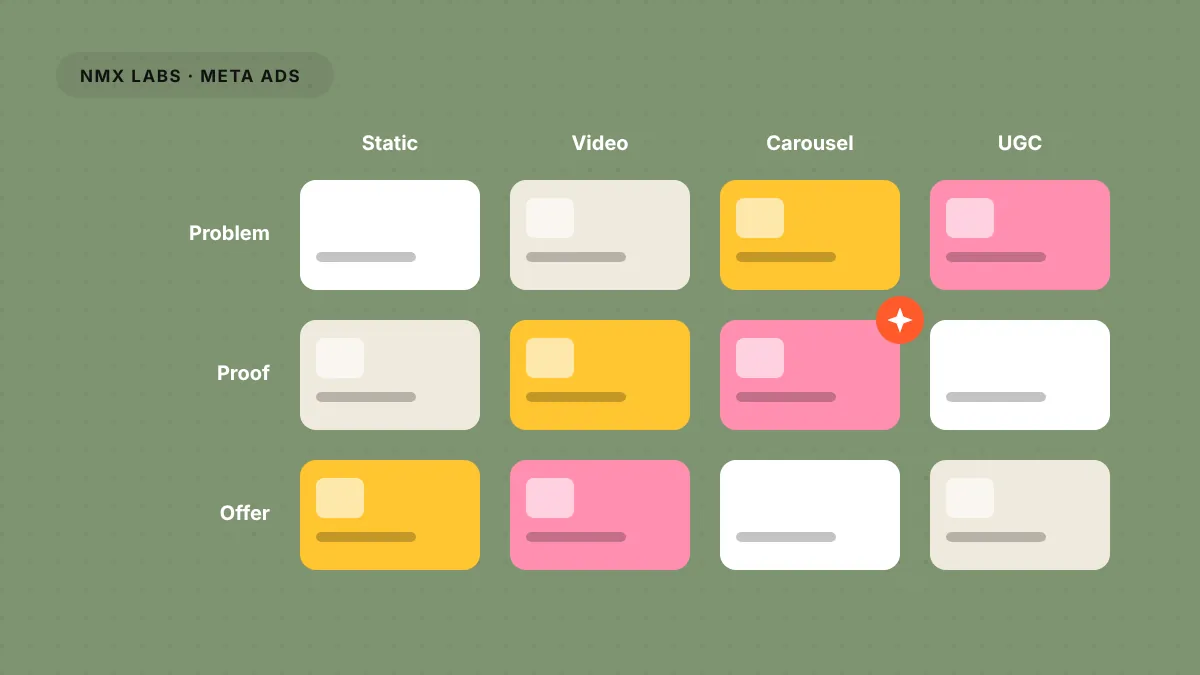
The system is the grid of angles × hooks × formats. You don’t fill every cell. You pick a few, launch, read, and then fill more cells next to the ones that worked.
Name everything so the data means something
If your ads are called “Final_v3_new”, you can’t learn anything from a report. We use one naming pattern across every ad:
Angle_Hook_Format_Size_Version — for example Price_Question_Static_4x5_v1.
Now you can sort the Ads Manager report and see that, say, price-angle ads beat ingredient-angle ads across formats, which is a far more useful finding than “ad 14 did well”.
Sizes and safe zones
We design every concept in two masters:
- 4:5 (1080 × 1350) for Feed. It takes more screen height on a phone than 1:1.
- 9:16 (1080 × 1920) for Stories and Reels.
On 9:16, the top and bottom of the screen are covered by profile names, captions and buttons. Keep logos, text and the product away from those strips, and check every export against Meta’s current safe-zone overlay rather than guessing, because the interface changes. A beautiful ad with the price hidden under the CTA button is a wasted impression.
How we test
Our default rhythm for a brand spending steadily every month:
- Launch a test set of three to five new concepts, each a different angle, so the test answers a real question.
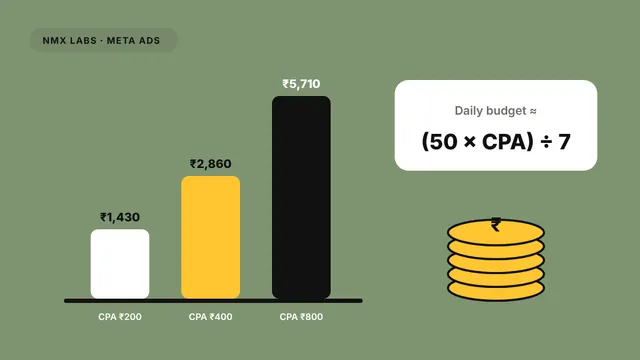
- Give them enough budget to leave the learning phase. See our Meta budget guide for the maths.
- Judge after enough spend, not after a day. Early results swing wildly. We look at results once each ad has spent a meaningful multiple of the target cost per result.
- Promote winners into the main scaling campaign and iterate on them: new hooks, new formats, same angle.
- Retire losers without debate, and note what you learned in a shared sheet.
The metrics we actually read
| Metric | What it tells you | If it’s weak, fix |
|---|---|---|
| Hook rate (3-second video plays ÷ impressions) | Whether the opening stops the scroll | The first frame and first line |
| Hold rate (ThruPlays ÷ 3-second plays) | Whether the video keeps attention | Pacing, length, story |
| Link CTR | Whether the ad makes people want to know more | Angle, offer, CTA clarity |
| Conversion rate on landing page | Whether the page keeps the ad’s promise | Landing page, not the ad |
| Cost per result (CPA) | The business outcome | Read the metrics above to find the cause |
The point of the table is diagnosis. A high CPA alone doesn’t tell you what to change. A strong hook rate with a weak CTR means people watched but weren’t convinced, so the angle or offer is the problem, not the editing.
When to refresh
Creative fatigues. The signs are a rising frequency in the same audience alongside a falling CTR and a rising cost per result. When a winning ad starts to tire, don’t replace it with something unrelated. Make new hooks and formats on the same winning angle first. That keeps what was working and gives the algorithm something fresh.
A worked example
Say a home-fragrance brand launches with four angles: long-lasting scent, natural ingredients, gifting, and price per day. For round one we make one static and one short video per angle, each with a different hook, in both sizes. That’s eight concepts and sixteen files, all named to the pattern.
After enough spend, gifting has the best cost per purchase across both formats, while natural ingredients has a strong hook rate but a weak CTR. Round two follows directly from that: three new hooks and a carousel for gifting (it’s working, so build around it), and a rewrite of the ingredients offer rather than its visuals (people are watching, the message isn’t landing). The long-lasting and price angles are paused and noted for a later test. Nobody argued about taste; the system told us what to make next.
Mistakes we see most often
- Testing ten things at once. If every ad differs in angle, hook, format and offer, a winner teaches you nothing you can repeat.
- Polishing too early. Expensive production for untested angles. Prove the angle with simpler creative, then invest in the winner.
- Only making statics, or only making video. Placements and people differ. Cover both.
- Killing ads on day one. Early numbers are noise. Set your judgment threshold before launch and stick to it.
Where design and media meet
This system is the reason we sell creative and Meta Ads management as one bundle. When the people reading the numbers also make the ads, a weak hold rate on Tuesday becomes a re-cut by Thursday, not a note in a monthly report.
Image credits
- *1 Hero illustration and infographics: original artwork by NMX Labs.
Related reading
 Meta adsMeta’s Andromeda, explained: why your ad creative now does the targeting
 Meta adsHow much should an Indian startup spend on Meta ads? A budget guide with the maths
 BrandingWhat goes in brand guidelines, and how to keep them short enough that people use them
- Watch on YouTubeVideo explainers: Meta ads creative testing strategy
More from Neeraj, our AI design expert, or browse every Meta ads post.

Comments
Questions, corrections or your own experience with this? Add it below. We read every comment and publish it after a quick check for spam.