Campa Cola’s comeback: how Reliance restarted the cola war on price
Reliance bought a 1970s cola for about ₹22 crore, put it in a 200 ml bottle at ₹10 and made Coca-Cola and PepsiCo cut prices. The interesting part isn’t the discount. It’s how a price point became the brand.
Key takeaways
- Reliance acquired Campa in 2022 for about ₹22 crore and relaunched it in 2023 with a 200 ml bottle at ₹10, roughly half what rivals charged at the time.
- Reported results are large: Campa crossed ₹5,250 crore in sales in the first half of 2026–27 and holds double-digit share in key markets, per Reliance’s results presentation.
- The ₹10 price works as a brand because it is a coin, sold mainly through kirana shops, backed by nostalgia and by distribution most challengers can’t afford.
- What D2C brands can copy is the memorable hero price and the channel focus. What they can’t copy is funding a price war against incumbents who can match them.
The most important number in India’s cola war isn’t a market share. It’s ₹10, a single coin, which is what Reliance asked for a 200 ml bottle of Campa when it brought the brand back. Three years on, the two global giants that had the category to themselves for decades have cut prices in places, Reliance is applying the same coin-price idea to ice cream and biscuits, and Campa has become one of the most talked-about brand revivals in Indian retail.
Most coverage calls this a price war. It’s more useful to read it as a brand strategy where the price is the positioning. Here’s how it worked, what the numbers say, and what a founder with a much smaller budget can take from it.
An old brand, bought cheap
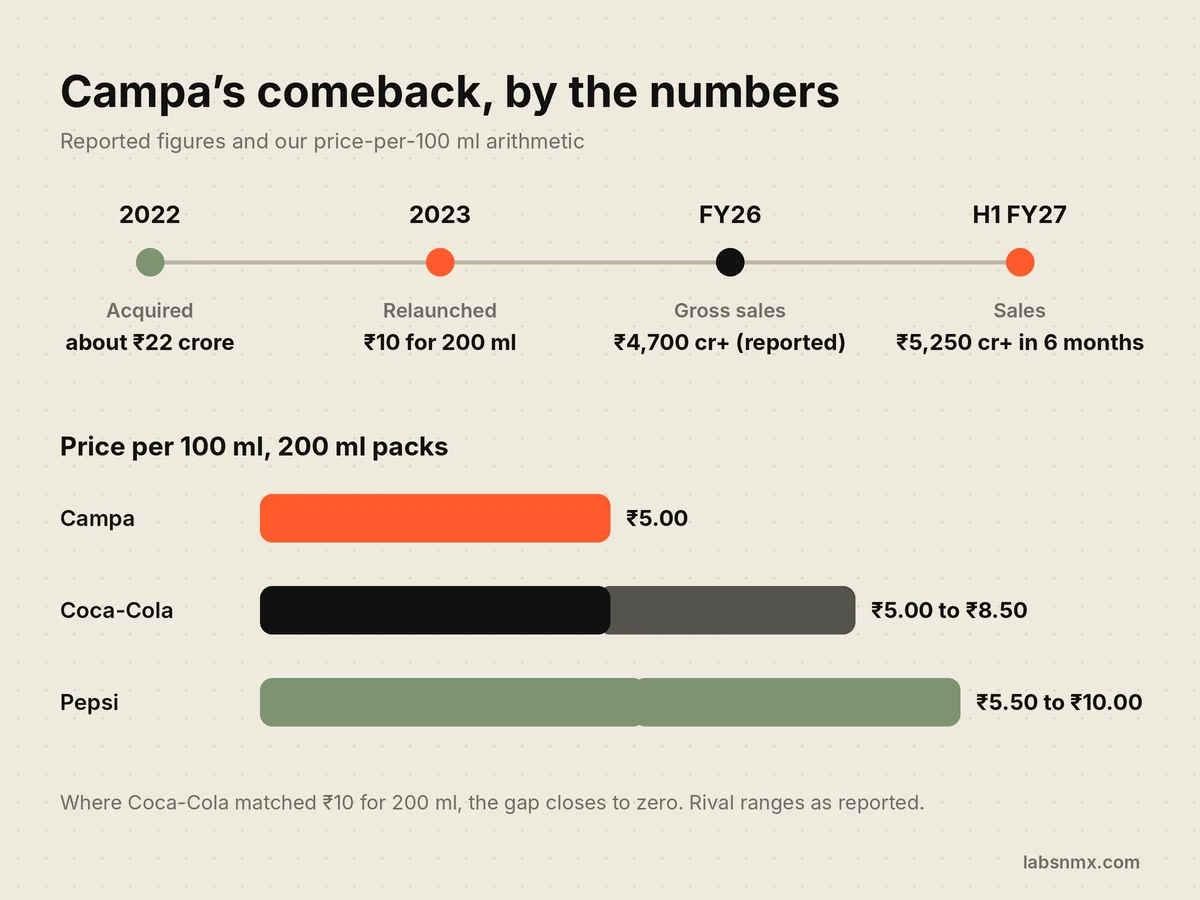
Campa was the cola of the late 1970s and 1980s, the years after Coca-Cola left India. It faded once the multinationals came back in the 1990s, but it never disappeared from memory, especially for anyone who grew up in north India. Reliance acquired the brand in 2022 for about ₹22 crore and reintroduced it in 202312.
That price is the first lesson. Building a new cola brand’s awareness from zero would cost many times more than ₹22 crore in advertising alone. Buying a name that a generation already recognises gave Reliance trust on day one, and a story the press was happy to tell for free.
The price that does the talking
At relaunch, Campa’s 200 ml bottle sold for ₹10, roughly half what comparable Coca-Cola and Pepsi packs cost at the time2. Later reporting put Pepsi’s 200 ml range at ₹11 to ₹20 and Coca-Cola’s at ₹10 to ₹17, with Coca-Cola selling 200 ml at ₹10 in some states in response5.
Why does a coin matter so much? Because most cold drinks in India are bought in small shops, on impulse, with whatever is in your pocket. A ₹10 price needs no change, no thought and no comparison. It turns the price itself into something people say out loud: “Campa, the ₹10 one.” Most brands spend years trying to own a word. Campa owned a number.
What the numbers say
Reliance has started publishing Campa figures in its results. In its second-quarter presentation for 2026–27, it said Campa crossed ₹5,250 crore in sales in the first half of the year, with double-digit market share in key markets3. Separate reporting on its 2025–26 results put Campa’s gross sales above ₹4,700 crore for that year and described it as India’s fourth-largest carbonated soft-drink brand by March 20264.
Industry estimates of the shift vary. One market note estimates that Coca-Cola and PepsiCo’s combined share slipped from about 93% to about 85%, with most of the movement at the ₹10 price point6. Deccan Herald’s reporting described Campa reaching around 10% share within a year or two of its return1. Treat these as directional, not audited.
The incumbents have responded the way incumbents do. Besides price cuts in some states5, the fight has moved into shops themselves: one report says Reliance, Coca-Cola and Pepsi together plan to buy around five lakh branded fridges in a year10. A visi-cooler at the front of a kirana shop is the last 30 centimetres of distribution, and everyone wants it.
We tried it: the arithmetic behind the coin
How we checked this
We converted the reported 200 ml prices into price per 100 ml, and tried to reconcile Reliance’s two published sales figures. All inputs come from the sources in the notes. The arithmetic is ours.
| Brand, 200 ml | Reported price | Price per 100 ml |
|---|---|---|
| Campa | ₹102 | ₹5.00 |
| Coca-Cola | ₹10 to ₹175 | ₹5.00 to ₹8.50 |
| Pepsi | ₹11 to ₹205 | ₹5.50 to ₹10.00 |
What it shows: where Coca-Cola matched ₹10, the price gap disappears completely. From that point Campa has to win on something other than price: availability, the fridge, the name. That’s why the battle has moved to distribution.
The numbers that don’t reconcile: Reliance’s presentation said the first half of 2026–27 sales were over 90% of the full previous year3. If ₹5,250 crore is 90% of 2025–26, the full year would be about ₹5,800 crore, not the ₹4,700 crore reported elsewhere4. The likeliest explanation is that the two figures use different definitions, such as gross versus net sales, or Campa alone versus the whole beverages line. We’re flagging it rather than picking one, and we’ll update this post if Reliance clarifies.
Why price became a brand here
1. It’s a coin, sold where coins are spent
About 70% of Reliance Consumer Products’ sales came through general trade in the first quarter of 2025–267. A ₹10 price is built for that channel: no change, no haggling, no comparison shopping.
2. Nostalgia lowers the cost of trying
A new cola at ₹10 sounds cheap. A cola your parents drank, at ₹10, sounds like a good deal. The old name does the reassuring that a new brand would have to pay for.
3. The price is backed by a system, not a promotion
A discount ends. A price point built into the product, packs, distribution and margins doesn’t. Reliance is now applying the same idea across its portfolio, with ice cream starting at ₹10 under Bombay Creamery and a packaged-water business it says became the country’s third-largest branded player by March 20268.
4. Not every category will follow
Biscuits are the next test. Britannia’s chief executive has argued Reliance may struggle to repeat the cola disruption there, partly because much of the biscuit market already sells at ₹5 and ₹109. A coin price only shocks a category that wasn’t already selling at coin prices.
What a D2C founder can copy, and what they can’t
| Copy this | Don’t copy this |
|---|---|
| A hero product at one memorable, round price people repeat to each other | Undercutting a giant that can match your price in a week |
| Picking the one channel where that price matters most | Selling below cost without a plan for when competitors respond |
| Borrowing trust from a name, a place or a memory customers already have | Relying on nostalgia when the product itself doesn’t deliver |
| Owning the last metre: shelf, fridge, first screen on the app | Spending on awareness before distribution is ready |
The practical version for a small brand is a hero price: one SKU at a number simple enough to become part of the name. Think of the snack brand known as “the ₹20 one” or the skincare trial kit everyone calls “the ₹99 kit”. It needs margins that survive the price, and a second reason to buy for the day a competitor matches it.
The bottom line
Campa didn’t win attention with a clever campaign. It won with a coin, an old name and the ability to put both in front of millions of shopkeepers. For most brands, a price war is a way to lose money slowly. Campa shows the rare case where price, product and distribution line up so well that the number becomes the brand. The lesson for everyone else is smaller and safer: make one price unforgettable, and make sure you can still afford it when the giants answer.
Notes and sources
- Deccan Herald: Classic ‘Reliance strategy’ helps Campa Cola carve a 10% market share ↩
- Goodreturns: Reliance revives Campa Cola with ₹10 pricing (acquisition value and launch price) ↩
- Business Standard, November 2026: Britannia to closely watch Reliance Consumer’s entry into the biscuit market (Campa H1 FY27 figures) ↩
- NiftyTrader: Reliance doubles FMCG revenue in FY26 (Campa FY26 gross sales, brand rank) ↩
- Whalesbook: Reliance’s Campa Cola ignites Indian beverage price war (reported rival price ranges) ↩
- Angel One: Campa and Lahori Zeera shake up India’s ₹60,000 crore soft-drink market ↩
- Business Standard, July 2025: Reliance Consumer Products on strong growth trajectory (Q1 FY26 revenue, general trade share) ↩
- Business Today, September 2026: Mukesh Ambani’s ₹10 power play, from Campa Cola to ice cream ↩
- Business Standard, November 2026: Reliance may struggle to repeat cola disruption in biscuits, says Britannia CEO ↩
- trak.in: Cola war, five lakh branded fridges to be bought by Reliance, Coca-Cola and Pepsi in 12 months (reported) ↩
Image credits
- *1 Hero illustration: original artwork by NMX Labs.
- *2 Infographic: original artwork by NMX Labs, using the figures cited in the notes. You may reuse it with a link to this page.
Related reading
 Brand storiesThe 10-minute war: how Blinkit, Zepto and Instamart are fighting with brand, not just dark stores
 Brand storiesAmul made memes before the internet: what 60 years of topical ads teach brand teams about moment marketing
 Brand storiesWhy Zomato renamed itself Eternal: the house-of-brands bet behind India’s best-known food app
- Watch on YouTubeVideo explainers: Campa Cola comeback Reliance
More from Anisha, or browse every Brand stories post.
Comments
Questions, corrections or your own experience with this? Add it below. We read every comment and publish it after a quick check for spam.