Why Zomato renamed itself Eternal: the house-of-brands bet behind India’s best-known food app
In 2025 Zomato Ltd became Eternal Ltd, but the app you open at 11 pm kept its name. A year later the founder handed the group CEO job to the man who runs Blinkit. Both moves tell the same story, and it’s a story about brand architecture.
Quick summary
- Only the listed company was renamed. Zomato the app and brand stayed exactly as it was, alongside Blinkit, District and Hyperpure.
- The company had used “Eternal” internally since buying Blinkit in 2022, to separate the corporate entity from the consumer app.
- Blinkit’s growth is the real reason: quick commerce became the group’s biggest business, and Blinkit’s founder became group CEO in February 2026.
- For founders: rename the company, not the consumer brand, once a second business is big enough to be confused with the first.
Summary by Anisha. Prefer an AI take? Ask Google AI to summarise it (opens in a new tab).
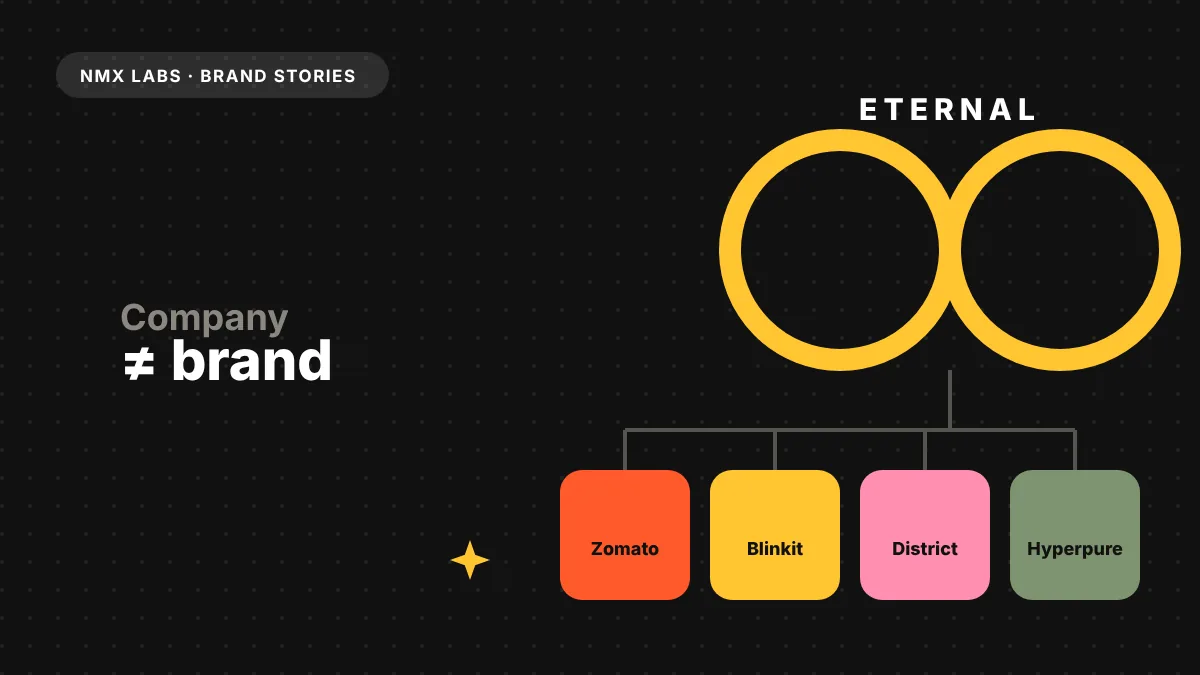
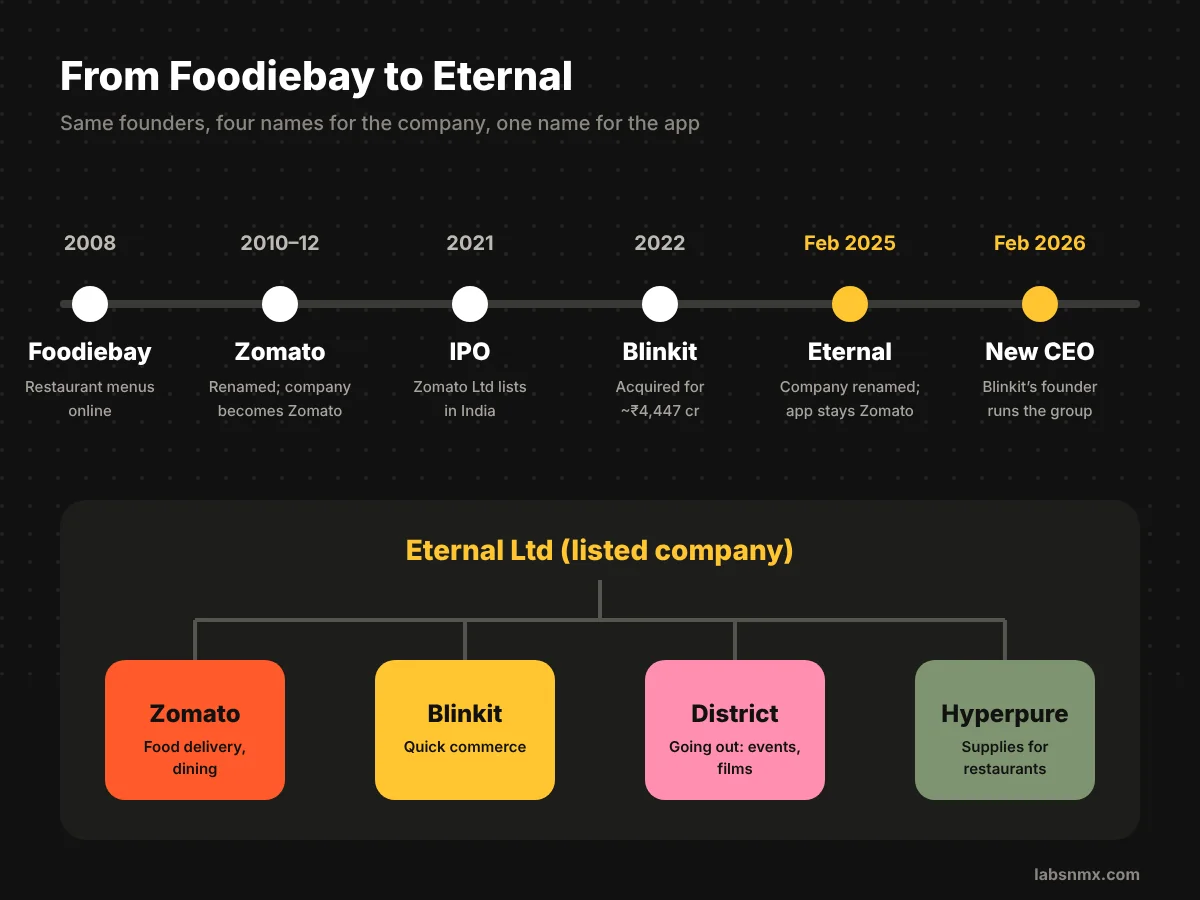
On 6 February 2025, Deepinder Goyal sent shareholders a letter that read like a rebrand announcement and wasn’t quite one. Zomato Limited, the company listed on the stock exchanges, would become Eternal Limited. Zomato, the red app with the restaurant listings and the cheeky push notifications, would stay Zomato.


Most coverage treated it as a name change. It’s more useful to read it as a decision about brand architecture: how a company with several businesses decides which names customers see, which names investors see, and which name gets the credit when something goes well.
What actually changed, and what didn’t
The renamed entity now sits above four businesses: Zomato for food delivery and dining out, Blinkit for quick commerce, District for going-out experiences like events and movies, and Hyperpure, which supplies restaurants. Goyal was explicit that the rename applied to the company and not to the brand or the app. The corporate website moved to eternal.com and the stock ticker changed from ZOMATO to ETERNAL once the Ministry of Corporate Affairs approved it in March 2025.
For a customer, nothing moved. For an investor, an employee or a journalist, the company now has a name that isn’t also the name of one of its products.
“This isn’t just a name change; it is a mission statement.”
The name was already in use for three years
The detail most people skipped: Goyal said the team had been calling the company Eternal internally since it acquired Blinkit, formerly Grofers, in 2022 for about ₹4,447 crore. The reason was practical. When one company owns two consumer brands, “Zomato” in a meeting becomes ambiguous. Do you mean the food app or the group that also owns a grocery business?
That ambiguity is the signal every growing company should watch for. If your own team needs a nickname to tell the parent apart from the product, your customers and investors are probably confused too.
Branded house, house of brands, or something in between
Brand strategists sort multi-business companies into three rough models. Which one you choose decides how much each new business borrows from the brand you already built, and how much risk it can pass back.
| Model | How it works | Indian example | Trade-off |
|---|---|---|---|
| Branded house | One master name on everything | Tata (Tata Motors, Tata Tea, Tata Neu) | New launches inherit trust instantly, but one bad story touches every business |
| Endorsed brands | Own names, with the parent as a stamp of approval | Courtyard by Marriott, or “a Tata product” style sign-offs | A middle path: some borrowed trust, some separation |
| House of brands | Separate consumer names, a quiet corporate parent | Eternal: Zomato, Blinkit, District, Hyperpure | Each brand can own its category, but each has to earn its own awareness |
Eternal is now a textbook house of brands, the model Google adopted when it created Alphabet in 2015 so that Google could remain the search brand while other bets lived beside it. The parent name is abstract on purpose. It doesn’t describe food or groceries because it has to sit above businesses that don’t exist yet.
Why it happened when it did: Blinkit got big
A rename this visible only makes sense once the second business is too large to describe as a side project. By the quarter ending June 2025, Blinkit’s gross order value had passed that of Zomato’s food delivery business, making quick commerce the group’s largest business by that measure. A parent company named after the smaller business was starting to look like a mislabelled box.
The leadership change followed the same logic. On 21 January 2026, Goyal announced he would step down as group CEO from 1 February, with Blinkit founder Albinder Dhindsa taking over day-to-day execution and Goyal staying on the board as vice chairman. Goyal said he wanted to pursue riskier ideas that don’t fit inside a listed company. Whatever the personal reasons, the result is a group run by the founder of its biggest business, under a name that belongs to none of them.
What founders and brand teams can take from this
1. Rename the company, not the brand customers love
Zomato had years of earned recognition, a distinctive red and a voice people quote back. Renaming the app would have thrown that away for no customer benefit. The corporate layer is where a new name costs least.
2. Watch for the “internal nickname” moment
If your team has started saying “the group” or using a code name to separate the parent from the product, write down why. That reason is usually the brief for your brand architecture.
3. Choose a parent name that can hold things you haven’t built yet
Descriptive names age badly when a company expands. Abstract or aspirational names, like Eternal or Alphabet, survive new categories. The trade-off is that they mean nothing to customers, which is fine, because customers aren’t supposed to see them much.
4. Decide what happens when one brand has a bad week
A house of brands contains damage. A food-safety complaint about one restaurant on Zomato doesn’t need to touch Blinkit’s reputation. In a branded house, the same story can follow every product with the shared name.
5. Small brands can do a lighter version
You don’t need four businesses to use this thinking. If a D2C skincare brand launches a men’s line, the same question applies: a new name endorsed by the parent, or the parent name with a descriptor? Getting that right early saves a costly rename later. Our brand guidelines post covers how to document whichever model you pick, and checking trademarks before you commit to a new name is in our trademark guide.
The bit nobody can answer yet
A house of brands is a bet that each business is strong enough to stand alone. It works brilliantly when every brand pulls its weight and gets expensive when a new launch has to build awareness from zero without the parent’s help. District, the newest of the four, is the test case worth watching.
Sources
- Eternal: Deepinder Goyal’s letter to shareholders, 6 February 2025
- TechCrunch: India’s Zomato to rebrand as Eternal
- YourStory: Zomato umbrella company to now be called Eternal
- Inc42: Zomato is now officially Eternal as MCA confirms name change
- Business Today: Renaming Zomato to Eternal drives home the multifaceted nature of business
- Deccan Herald: Goyal resigns as CEO of Eternal; Dhindsa to take over
- Business Standard: Deepinder Goyal steps down as CEO of Eternal Group
- Digital in Asia: India quick commerce 2026 (Blinkit GOV vs food delivery)
Image credits
- *1 Hero illustration and infographics: original artwork by NMX Labs.
- *2 Eternal logo, a trademark of Eternal Ltd, shown for identification only. Image: copy from the NMX Labs image library (supplied by our editor).
- *3 Zomato logo, a trademark of Eternal Ltd, shown for identification only. Image: Simple Icons (simpleicons.org), brand icon, loaded from cdn.simpleicons.org.
- *4 Blinkit logo, a trademark of Eternal Ltd, shown for identification only. Image: Simple Icons (simpleicons.org), brand icon, loaded from cdn.simpleicons.org.
- *5 District logo, a trademark of Eternal Ltd, shown for identification only. Image: copy from the NMX Labs image library (supplied by our editor).
- *6 Hyperpure logo, a trademark of Eternal Ltd, shown for identification only. Image: copy from the NMX Labs image library (supplied by our editor).
Related reading
 Brand storiesThe 10-minute war: how Blinkit, Zepto and Instamart are fighting with brand, not just dark stores
 BrandingWhat goes in brand guidelines, and how to keep them short enough that people use them
 Brand storiesSwiggy vs Zomato: the push-notification copy war, and why brand voice beats discounts
- Watch on YouTubeVideo explainers: Zomato renamed Eternal explained
More from Anisha, our market research lead, or browse every Brand stories post.
Comments
Questions, corrections or your own experience with this? Add it below. We read every comment and publish it after a quick check for spam.